free html hit counter Peak Oil Debunked

Saturday, November 17, 2007

314. PEAK OIL AND FERTILIZER: NO PROBLEM

The idea that nitrogen fertilizer production is dependent on oil and gas is a myth -- a really stubborn and persistent myth. In fact, just this morning I woke up to find yet another uninformed bozo spreading the big lie:
If we are unprepared for Peak Oil the potential outcome may be devastating for our way of life and that of the world. Unfortunately Peak Oil is expected to coincide with Peak Food because oil is required for food growth and delivery.Source
We can debate the part about delivery, but the part where it says "oil is required for food growth" is nothing but pure, straight-from-the-rump bullshit.

I have previously addressed this issue in a number of posts: 28. ISN'T FERTILIZER MADE FROM CRUDE OIL?, 174. ARE HIGH FERTILIZER PRICES A THREAT TO THE FOOD SUPPLY?, and 176. THE OIL-BASED FERTILIZER MEME. But this myth really dies hard. So allow me to explain again, and hopefully enlighten a few more people to the actual facts.

I'd also like to enlist the help of the rational wing of the peak oil movement. Can we redouble our efforts to challenge this myth, and ensure that the general public has access to the truth instead of endless repetition of the same lie?

The key facts are very simple:

1) You don't need oil, natural gas, coal or any other fossil fuel to make nitrogen fertilizer.
2) All you need to make nitrogen fertilizer is air, water and energy.

back40, a soil scientist from the blog Muck and Mystery, has a great post describing the situation*:
Natural gas, methane, is a common feedstock for nitrogen fertilizer production since it has four nice hydrogen atoms, which is what is of use for fertilizer, and it is used as an energy source for heat and pressure production to enable the catalyzed reactions to take place.

But that's just one way to make ammonia, the simplest type of nitrogen fertilizer. At the turn of the century ammonia was a waste byproduct of coke production from coal that was sold as an industrial chemical and later as fertilizer. This is still so. But coal is still a fossil fuel albeit a much more abundant one. This debunks the peak oil whingers but not the anti-fossil whingers.

The earlier post Fire Down Below noted Iceland's use of geothermal energy and efforts to greatly increase production. One of their proposed uses of all that energy is to make hydrogen from water and export it around the world. They could use that hydrogen to make ammonia fertilizer and export that instead. It might be easier and more profitable.

Any energy system could be used to make hydrogen. We've heard of wind farms planning to use their peak output energies to make hydrogen as a way of storing the energy from intermittent winds. The hydrogen is a sort of battery in the sense of being charged up when the wind blows and drawn down between times, and thus overcoming one of wind's limitations as an energy system. Hydroelectric power has been used to make hydrogen and fertilizer too. All of these energy sources and hydrogen sources use no fossil fuels, just air and water, to make fertilizer.
There are numerous historical examples of firms making fertilizer from hydroelectric power:

Norsk Hydro:
A week after meeting, Eyde and Birkeland submitted a patent for artificial fertilizer. They obtained money from the Swedish financiers, the Wallenbergs, and a mere three years later a hydroelectric plant had been built out of the wilderness at Notodden and a Birkeland-Eyde arc furnace was producing the first Norgesalpeter - Norwegian Saltpeter, i.e. calcium nitrate.Source
Yara:
Among pioneers in nitrogen fertilizers
In 1909, a new power plant was built at Nera Montoro and the work to develop ammonia synthesis technology started, headed by Dr Luigi Casale. Italian scientists and engineers were very much part of the fertilizer technology race of the early 20th century.

Ammonia production based on the Casale process started at Nera Montoro in 1922/23 with a capacity of 14 tonnes per day. Synthesis gas for the ammonia converter was based on hydrogen from water electrolysis and nitrogen from the air.Source
A New York Times article from March 5, 1922, describes various projects to produce fertilizer using hydroelectric power: Food from the Air.

The Minnesota Central Research and Outreach Center (MCROC) is currently developing a prototype system to manufacture nitrogen fertilizer from wind, air and water:
The WCROC Wind to Hydrogen to Ammonia pilot facility is currently under design. The major equipment will be ordered Fall 2007. Construction is targeted for Spring 2008 and the facility should be in operation in Summer 2008. The system will feature a 400 kW electrolyzer and a modified Haber Bosch reactor that will produce a maximum of 1 ton per day or 365 tons of ammonia per year. The reactor will be approximately the size of a 50 gallon drum. Once in operation the facility will produce anhydrous ammonia for use on the West Central Research and Outreach Center fields in addition to some excess which will be sold or used in other energy systems.Source (Also see here.)
Even Richard Heinberg concedes that fossil fuels are not necessary to produce fertilizer:
Organic or ecological agriculture can be even more productive in some situations than industrial agriculture, but local success cannot make up for the fact that the total amount of nitrogen available to crops globally has been vastly increased by the Haber-Bosch ammonia synthesis process, which is currently dependent on fossil fuels. Ammonia synthesis could be accomplished with hydrogen, which could in turn be produced by hydroelectric hydrolysis; but the infrastructure for such production is currently non-existent. (Source: The Party's Over, P. 197)
Clearly no fossil fuels whatsoever are needed to manufacture nitrogen fertilizer. All you need is an energy source (hydroelectric, solar, wind, wave, geothermal, nuclear etc.), air and water. And none of these are even remotely facing a supply crisis.

Therefore, the supply of fertilizer is not threatened by peak oil, peak gas or even peak coal.

Of course, we can expect the doomers to make yet another last ditch rebuttal: "Yah, well, so what. Just because we can make nitrate without fossil fuels doesn't mean that we will."

Sorry, but I can assure you with 100% certainty that we will continue producing huge volumes of nitrates from the air, long after fossil fuel has been entirely exhausted. How do I know this? Simple: In addition to being fertilizer, nitrates are the active ingredient of gun powder and bombs. So, yes, nitrate facilities will be up and running, as a matter of national security, so we might as well use them to feed ourselves in peace time.
by JD
----
*) Part 2 of this article Fossil Fertilizer is also really good. Great summary of the history and future of nitrate.

Friday, November 25, 2005

174. ARE HIGH FERTILIZER PRICES A THREAT TO THE FOOD SUPPLY?

Nitrogen fertilizer is made from natural gas (NG), and recently we've been hearing a lot about how high NG prices are putting the crunch on US farmers. For example (as we saw in #112) the fertilizer lobby is teaming up with the oil industry to push drilling in ANWR, Lease Area 181 and the OCS (Outer Continental Shelf). The industry PR tugs at your heart strings: "U.S. farmers provide a safe and abundant food supply for the entire world." Apparently, American agriculture is feeding the world like UNICEF and Bob Geldof. We're also being pelted with a steady stream of media sob stories about Joe the patriotic farmer, withering under the high nitrogen prices while he toils out on the back 40. For the peak oiler, this is how the die-off begins. Food is oil, and food shortages begin to occur as the price of fossil fuel inputs rises.

But is fertilizer in the U.S. really about food?

Here's some interesting figures on total fertilizer consumption (by crop) in the U.S.:
Corn: 41%
Soy beans: 6%
Cotton: 5%
Sorghum: 1.5%
Tobacco: 0.5% Source

That's most of U.S. fertilizer use (54%) right there. Now -- being as it's thanksgiving and all -- what would you say if you went to your relatives' house for the holiday dinner, and they were serving corn, soy beans, cotton, sorghum and tobacco? How much of that stuff do you actually eat? Not much, I suspect.

For comparison, the U.S. uses 13% of its total fertilizer for wheat, and only 4.5% of its fertilizer for all fruits and vegetables combined.

In other words, the fertilizer "crisis" is about $$MONEY$$, not food. The expense accounts of the fertilizer lobby aren't being paid by farmer Joe back in the Ozarks. The fertilizer lobby is being paid by Cargill, and operations growing ethanol corn for government subsidies. The threat to the food supply is just lobbyist spin. In reality, the NG crunch is primarily a threat to profit margins.
-- by JD

Monday, September 08, 2008

376. NITROGEN USE EFFICIENCY (NUE)

One of the most far-fetched peak oil scares is the idea that peak oil is going to cause mass starvation because fertilizer is dependent on oil. This isn't even remotely true, and if you're new to peak oil, this article has all the info/links you need for a more realistic understanding: PEAK OIL AND FERTILIZER: NO PROBLEM.

Generally, the peak oiler alarmist approach is to look at the fertilizer problem (and everything else about peak oil) strictly through the lens of supply, i.e.: We need natural gas to make fertilizer, and when gas starts running low, we're going to be in big trouble. Even that statement is wrong (because fertilizer can be made from coal, or hydropower, or nuclear), but it also ignores the potential for innovation on the demand side, which is where the real action is at the moment.

For example, Arcadia Biosciences has developed nitrogen-efficient crops which provide the same yields with 1/2 to 1/3 the fertilizer:
...farmers can reduce the overall amount of nitrogen required by employing new biotechnologies, such as the nitrogen use efficiency (NUE) improvements offered by Arcadia Biosciences. By engineering crops to overexpress a gene that allows roots to absorb more nitrogen, Arcadia scientists have shown that "it's possible for NUE crops to produce the same yield with half as much fertilizer," president and CEO, Eric Rey, says. "In canola, we saw a two-thirds reduction."

Seeds bearing the technology have already been licensed to agricultural giants Monsanto Company and Dupont's Pioneer Hi-Bred International in the case of canola and corn, respectively—and even grass seed from Scotts Miracle-Gro Company may one day employ it. Although field trials over the last four years have proved the genetic changes effectiveness, further testing and government approval means that such crops will not be grown before 2012.

"It's a big economic benefit for farmers if they use only half as much nitrogen as well a big beneficial impact on nitrogen runoff into waterways," says Rey, who hopes that this product will be adopted as quickly as herbicide-resistant crops, which only took five years from introduction in 1998 to become nearly 70 percent of the corn grown in the U.S., and is now nearly 90 percent. "A reasonable expectation is that there would be a dramatic reduction, maybe by 2018."Source
The Chinese recently announced a nationwide release of genetically-engineered rice, and are working with Arcadia to develop nitrogen-efficient rice:
China says short world grain supplies have persuaded it to release biotech rice nationwide, ensuring the broadest-ever use of genetic engineering in a food crop. Chinese plant breeders say biotech crops are certain to produce higher yields, forestalling the need to finance costly rice imports for China’s billion-plus consumers.

[...]

The Chinese have already developed genetically engineered rice strains with bred-in pest and disease resistance. They’re also experimenting with new nitrogen-efficient rice that needs only half as much fertilizer to get top yields. The new rice thus costs much less to grow, and emits far less greenhouse gas per ton of rice produced. They also say biotech rice “escapes” will not be a problem, since they’ve pre-programmed the rice to be hyper-sensitive to a particular herbicide.Source
This is a hot area, and Monsanto is also in the game:
Monsanto is developing corn that will yield better under normal nitrogen conditions, or to stabilize yield in low nitrogen environments. Last year, the company’s nitrogen trials demonstrated a 5 to 15 percent yield increase across limited nitrogen environments. Across three locations in Illinois and Iowa in 2006, Monsanto’s lead N utilization gene showed no yield drop-off as the N application levels decreased from 180 pounds per acre to 40 lbs./acre. Just recently, Monsanto and a company called Evogene announced a collaboration to improve nitrogen use efficiency in corn, soybeans, canola and cotton. Source
Conclusion: The peak oil "fertilizer crisis" continues to recede into the distance like the silly fantasy it is.
by JD

Sunday, September 11, 2005

90. CORN AND FERTILIZER

Let's recall the "die-off" scenario, as concisely described by Wikipedia
Some envisage a Malthusian catastrophe occurring as oil becomes increasingly inefficient to produce. Since the 1940s, agriculture has dramatically increased its productivity, due largely to the use of chemical pesticides, fertilizers, and increased mechanisation. This process has been called the Green Revolution. The increase in food production has allowed world population to grow dramatically over the last 50 years. Pesticides rely upon oil as a critical ingredient, and fertilizers require both oil and natural gas. Farm machinery also requires oil. Arguing that in today's world every joule one eats requires 5-15 joules to produce and deliver, some have speculated that a decreasing supply of oil will cause modern industrial agriculture to collapse, leading to a drastic decline in food production, food shortages and possibly even mass starvation.Source
This is complete bollocks, as we have seen from numerous previous articles (see #15, #22, #28, #46, #48, #55, #72, #76, #84 and #87), but fertilizers are a key factor, so let's look at them once again, and see where they actually go.

In 1999, corn (maize) accounted for about 41% of all fertilizer consumption in the U.S. The exact breakdown by fertilizer type was:
N (Nitrogen): 40.58%
P2O5 (Phosphate): 39.45%
K2O (Potash): 41.89% (Source: U.S. Fertilizer Application Rates, The Fertilizer Institute)

Where does all that corn go? You can see in the following chart:
Source

Most U.S. corn is used to feed livestock (dark blue); another large chunk is used for ethanol (purple); another large chunk is exported (yellow); and another large chunk goes into stocks (green). The part consumed by humans, directly as food, is a subset of the orange band, which represents FSI (Food, Seed and Industrial). This category also includes high fructose corn syrup (HFCS) which is a component of soft drinks, juices and ice cream, and a major cause of obesity. The USDA notes: "Food and starch, other segments of FSI use, are mature markets and projected gains largely reflect population growth."

This is further evidence that human beings aren't even close to the point of die-off due to the inability to produce enough food from the earth.

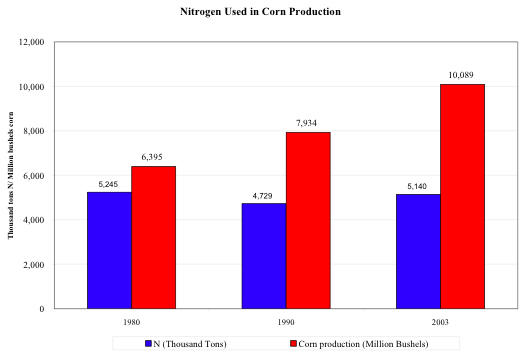
Here's another interesting data point from the Fertilizer Institute (click on the image for a clearer picture):

From the report:
Since 1980, corn production has increased by 57.8 percent. Interestingly, that increase was achieved using less nitrogen fertilizer. Notably, in 1980, nearly 6.395 billion bushels of corn were produced using 5.245 million tons of nitrogen. However by 2003, U.S. corn production soared to 10.089 billion bushels, even as the amount of nitrogen fertilizer used dropped to 5.14 million tons. Source
So, as we've seen earlier (#84), growth in the food supply is not dependent on growth in production of nitrogen fertilizer, and thus is not dependent on growth in the supply of oil or natural gas.

Thursday, August 18, 2005

28. ISN'T FERTILIZER MADE FROM CRUDE OIL?

ANSWER: No. Oil is not used in the production of fertilizer. The macronutrients required by plants are N (Nitrogen), K (Potassium) and P (Phosphorus). Oil is hydrocarbon, made from H (Hydrogen) and C (Carbon). There are no plant nutrients in oil.

Nitrogen fertilizer (N) is made from ammonia, which in turn is manufactured from natural gas, not oil. Natural gas is not peaking, but when it does, fertilizer can be produced from coal, as is done in China today:

For economic and environmental reasons, today natural gas is the feedstock of choice. The use of natural gas is accelerating rapidly, because of economic factors but also and increasingly due to environmental pressures, which work against other fossil fuels. Natural gas is expected to account for about one third of global energy use in 2020, compared with only one fifth in the mid-1990s. However, processes for ammonia production can use a wide range of energy sources. Thus, even when oil and gas supplies eventually dwindle, very large reserves of coal are likely to remain. Coal reserves are sufficient for well over 200 years at current production levels, and their location is geographically diverse. 60% of China's nitrogen fertilizer production is currently based on coal. Source*


Even when coal runs out, there will still be plenty of ammonia available because vast quantities of it are produced daily in the form of human and animal urine (which, ideally, we should be using for fertilizer right now).

Finally, potassium (K) comes from potash, and phosphorus (P) comes from phosphate. Both are mined minerals in plentiful supply.

PEAK OIL POSES NO THREAT WHATSOEVER TO THE SUPPLY OF FERTILIZER
------

For more information on peak oil and fertilizer, please see:
314. PEAK OIL AND FERTILIZER: NO PROBLEM and
321. PEAK PHOSPHORUS? HIT THE SNOOZE BUTTON

Monday, November 28, 2005

176. THE "OIL-BASED FERTILIZER" MEME

As we've seen in #28, fertilizer is not made from crude oil. It is made from natural gas, coal and even water (via hydroelectric electrolysis).

I know from experience that "fertilizer is made from oil" is a pernicious bit of misinformation which arises frequently in peak oil circles. However, the other day, I was confronted by a person who said that no authoritative peak oil expert claims that "fertilizer is made from oil". That is generally true, but wherever the meme came from, the fact remains that it is widespread in peak oil circles, and is a good indicator of the degree to which lies are being spread by irresponsible peak oil doom sites. Check out all these commentators talking about "oil-based fertilizer":

peak oil
"Do you buy food products grown with oil based fertilizers and pesticides, harvested by petroleum fueled vehicles, transported using petroleum, ..."
www.naturalchoice.net/articles/peakoil.htm

democracyforcalifornia.com: California Rolls Toward Hydrogen
"because bio-diesel crops require oil-based fertilizers to produce."
www.democracyforcalifornia.com/blog/archives/000637.html

Peak Oil Crisis
"After the Korean war, it had developed a modern farming system depending on machinery and oil-based fertilizers. After the Soviet Union fell, Communist aid ..."
www.oildecline.com/crisis.htm

EcoCity Cleveland | Transportation Choices
"Starvation will abound because oil-based fertilizers we've grown to depend on will be in short supply. Energy wars could erupt to control the remaining oil ..."
www.ecocitycleveland.org/transportation/pd_peak_oil.htm

OilPeaks.com - Dam Or Damn The Nile? Peak Oil Weekly In House ...
"It was decided that oil based fertilizers would now be used to make the fields along the Nile, bloom. In essence, the farmers have lost the power to control ..."
www.oilpeaks.com/week/article4.html

Odeo: The End of the Oil Age
"The food we eat: grown with oil-based fertilizers, pesticides and other
petrochemicals, sowed by oil-powered tractors and machinery. ..."
www.odeo.com/audio/318214/view

Democratize Energy Production--Reclaim Democracy.org
"We even slather oil-based fertilizers and herbicides on our food crops. We have allowed our addictions to overtake our common sense and a good portion of ..."
www.reclaimdemocracy.org/articles_2004/democratize_energy_laduke.html

OilPeaks.com - Jobs, Renewable Energy and The Economy. Peak Oil ...
"Gains in employment will happen in farming as oil based fertilizers become increasingly expensive. Hard working organic farmers will have to do more with ..."
www.oilpeaks.com/week/article2.html

Organise: Article / Why do they hate us?"
"Transportation depends on gasoline. Food depends on oil-based fertilizer and pesticides. Clothing, housing, and other things widely use oil-based plastics. ..."
flag.blackened.net/infohub/organise/content.php?article.609

:: I WANT CHANGE!!! iwantchange.org ::
"... For everything we have, everywhere we go, everything we do depends on cheap oil.
Using oil-based fertilizers produces our abundant and cheap food. ..."
iwantchange.org/news_detail.php?id=92

Lots more here.
-- by JD

Saturday, September 24, 2005

112. FERTILIZER LOBBY JUMPS ON DRILLING BANDWAGON

As we've seen earlier (#97), Matt Simmons has had a hard-on for years to drill ANWR, the OCS (Outer Continental Shelf) and Lease #181 in the eastern Gulf of Mexico.

The fertilizer lobby is now jumping on the same bandwagon:
"U.S. farmers provide a safe and abundant food supply for the entire world. Agriculture is the basis for the reliable food, fiber, feed and now energy for the United States and many others around the world. Like any other industry we need a reliable supply of inputs including fertilizer and fuel," said Leon Corzine, NCGA president. "Farmers are being impacted now with the high prices of fertilizer, natural gas and diesel at a time when our energy needs are at their highest. As an energy dependent nation, it is more important than ever that we diversify our nation's supplies of natural gas by using domestic resources and bringing stabilization to our supply". The Alliance members are urging Congress to reform public policies that create demand for certain energy resources, like natural gas, while restricting access to supply sources. According to the Minerals Management Service, there is an estimated 406 trillion cubic feet of natural gas in the Outer Continental Shelf. This potential supply is clearly needed, yet it is off limits due to federal policies that leave 85 percent of all federally controlled offshore areas subject to a federal moratoria on development. The moratoria that were put into effect 24 years ago must be reexamined to reflect the new reality of short supply and greater demand. Advanced drilling technologies have proven that these energy resources can be produced in an environmentally responsible manner.
The agricultural community believes that it is strategically critical for Congress to remove these production barriers now to provide new sources of natural gas and oil supplies. A high priority should be placed on opening up to exploration Lease Area 181 in the Gulf of Mexico which is known to have an abundant supply of energy resources with access to existing pipeline infrastructure. This action would facilitate speedy delivery of much needed natural gas to the marketplace. This area alone could insure that agriculture has access to natural gas to continue manufacturing fertilizer, grow our crops and feed our citizens. Source(pdf)
The fertilizer lobby is a crew of short-sighted fools who are only worried about their own pocketbook, and not the future well-being of the country or the world. Somebody high profile, in the congress or the media, needs to ask these fucking idiots one question:
What's the plan for when ANWR, Lease Area 181 and the OCS dry up?

Thursday, September 08, 2005

87. EATING URANIUM

One of the key "texts" of peak oil doom is "The Oil We Eat" -- a puff piece by Richard Manning, originally published in the Feb. 2004 issue of Harper's Magazine. The piece itself is basically a misanthropic screed which talks about humans "stealing" food from animals and the earth. It also spreads the lie (debunked in #28) that fertilizer is made from oil. Here's Manning in top form:
With the possible exception of the domestication of wheat, the green revolution is the worst thing that has ever happened to the planet.Source
Manning is clearly a doomer, and a traitor to the species, who thinks the earth would be a better place without people on it, because humans are a pestilence... a CANCER.

Still... the idea of "eating oil" is interesting. It makes you wonder: if we can eat oil, can we eat uranium?

The answer turns out to be: Yes. Nitrogen fertilizer can be produced from nuclear energy. Consider this:
About 97% of nitrogen fertilizers are derived from synthetically produced ammonia, the remainder being by-product ammonium sulphate from the caprolactam process and small quantities of natural nitrates, especially from Chile. The production of anhydrous ammonia is based on reacting nitrogen with hydrogen under high temperatures and pressures. The source of nitrogen is the air, the hydrogen being derived from a variety of raw materials, including water, crude oil, coal and natural gas hydrocarbons. The hydrocarbons provide the energy for the energy-intensive process. Source
As we have seen earlier, nitrogen fertilizer is not made from oil. It is made from natural gas (or syngas produced from coal). The interesting thing, though, is that the only part of the natural gas used in the production of ammonia (the basis of nitrogen fertilizer) is the hydrogen. Since hydrogen can be produced through the electrolysis of water, it is possible to produce fertilizer from WATER, as noted in the above passage. The energy necessary for producing the ammonia can also be derived from fission, so clearly (if necessary) we can turn uranium into nitrogen fertilizer.

In fact, we could even go a step further, and use uranium to supply light, heat and mechanization power for multi-story vertical farming facilities, located in the middle of the cities they feed. This would greatly increase the carrying capacity of the earth, eliminate fuel wasted on long-distance food transport, and reduce the human footprint due to agricultural activities:
Vertical farming practiced on a large scale in urban centers has great potential to:
1. supply enough food in a sustainable fashion to comfortably feed all of humankind for the foreseeable future;
2. allow large tracts of land to revert to the natural landscape restoring ecosystem functions and services;
3. safely and efficiently use the organic portion of human and agricultural waste to produce energy through methane generation, and at the same time significantly reduce populations of vermin (e.g., rats, cockroaches);
4. remediate black water creating a much needed new strategy for the conservation of drinking water;
5. take advantage of abandoned and unused urban spaces;
6. break the transmission cycle of agents of disease associated with a fecally-contaminated environment;
7. allow year-round food production without loss of yields due to climate change or weather-related events;
8. eliminate the need for large-scale use of pesticides and herbicides;
9. provide a major new role for agrochemical industries (i.e., designing and producing safe, chemically-defined diets for a wide variety of commercially viable plant species;
10. create an environment that encourages sustainable urban life, promoting a state of good health for all those who choose to live in cities. All of this may sound too good to be true, but careful analysis will show that these are all realistic and achievable goals, given the full development of a few new technologies.Source
THE LIVING TOWER (Night View)

Sunday, December 02, 2007

317. ELECTRIC AGRICULTURAL MACHINERY

I have conclusively demonstrated that peak oil does not threaten the fertilizer supply ( #314). That doesn't stop the doomers, however. They say: We're still screwed because agriculture is utterly dependent on oil to drive agricultural machinery. It can't be driven with electricity.

Here's "bandits" over at The Oil Drum:
I say to all the electric jackasses to get off and come back when the first commercial electric combine harvester, crop duster, bull dozer or fertilizer plant is constructed. Oh yeah and make sure that they are completely manufactured using "renewable" electric power.
We can now respond to bandits on the electric fertilizer plant. As referenced in 314. PEAK OIL AND FERTILIZER: NO PROBLEM, the first commercial electric fertilizer plant began operation around 1905, in Norway, and was a huge success.

How about that electric bulldozer? Well, here's a fully electric loader/backhoe, the ET-400 from Venieri:

It's interesting that the ET-400 was designed primarily as "green" construction equipment to reduce emissions and noise.

Here's a video of an electric plow prototype, the ET-7 built by Steve Heckeroth:

More photos and information on the ET-7 are available here and here.

The argument that electricity cannot handle farm work tends to focus on the most brutal farm tasks, like plowing. Can we develop an electric plow? The answer turns out to be yes. It was being done as early as 1937 in the USSR (see the source article for a photo):
TWO-WAY ELECTRIC PLOW IN USE IN SOVIET RUSSIA
The large hydroelectric plan on the Dneiper River in Russia's Dnepropetrovsk province makes it possible for them to use electric farm equipment like the two-way plow shown on the front cover of this week's Science News Letter.

No tractor is attached to the plow, which can reverse and travel in either direction. It is particularly useful on large areas of flat ground without rock like that on which the implement is pictured. (Science News Letter, October 23, 1937)Source
Apparently electric agriculture was all the rage as far back as 1879:
Already -- by 1879 in fact -- French engineers were plowing with electricity, adapting that power to the well-established British steam cable plowing system, utilizing two motors, one on each side of the field, to power windlasses alternately winding up steel cable and drawing a two-way plow to and fro between them."[from "Early Uses of Electricity in American Agriculture", Clark C. Spence, Technology and Culture, Vol. 3, No. 2. (Spring, 1962), p. 143.]
Spence cites an estimate that 1600 electric plows were operating in Germany at the end of WWI. It's a clever idea, isn't it? Plowing with just the blade/implement, and no tractor. Here's a slick variation from 116 years ago:
A novel cable approach was suggested in 1891 by an imaginative reader of the Rural New Yorker, who urged that an electric motor be located on a revolvable platfrom in the center of a field to draw in plows on radial lines by means of cable.[op.cit., p. 145]
Wow! That could be more than just an agricultural machine -- it could be a thrill ride. Put a pair of handlebars on the plow, and drag people at high speed through the soil for $3 a pop.
-- by JD

Wednesday, September 21, 2005

107. MANURE CALCULATIONS

In 2001/2002, the breakdown of fertilizer consumption in the U.S. was:
Nitrogen: 10.9 million metric tons (MMtonnes)
Phosphorus: 4.2 MMtonnes
Potassium: 4.5 MMtonnes (Source)

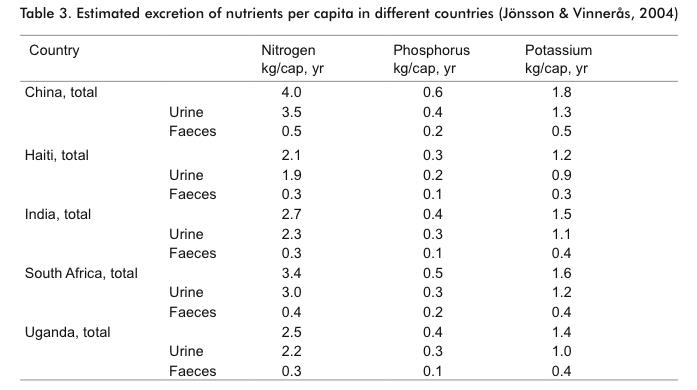
The following Table comes from a report by the Stockholm Environment Institute called "Guidelines on the Use of Urine and Faeces in Crop Production" Source(pdf), P. 6
In 2002, the population of the U.S. was about 288,000,000 (source: New York Times Almanac, 2004). Therefore, calculating from the Chinese values, the total fertilizer production in the U.S., per year, in the form of human urine/faeces is roughly:
Nitrogen: 1.1 MMtonnes
Phosphorus: .17 MMtonnes
Potassium: .5 MMtonnes

Percentages of total U.S. fertilizer use which could be supplied with human urine/faeces are thus:
Nitrogen: 10%
Phosphorus: 4%
Potassium: 11%

Now let's turn to the figures for livestock waste (click to enlarge).
Source
Fertilizer in livestock waste, per year, in the U.S. is roughly:
Nitrogen: 5 MMtonnes
Phosphorus: 1.3 MMtonnes
We can also get the following ballpark figure for potassium, assuming that animal waste contains 3 times as much potassium as phosphorus (as is the case for humans):
Potassium: 4.1 MMtonnes

Manure from humans + livestock can thus compensate for the following percentages of chemical fertilizer consumption:
Nitrogen: 56%
Phosphorus: 43%
Potassium: 102%

This is pretty good, although there are clearly a lot of leaks in the system which allow nutrients to escape the cycle. These include:
1) Run off waste (nutrients flowing into water)
2) Escape of volatile nitrogen into the air (ammonia)
3) Human carcasses which are not composted
4) Animal parts which are not composted (bones, blood, hides, teeth etc.)
5) Kitchen/yard/garden wastes buried in land fills
6) Food exports etc.

Wednesday, December 12, 2007

321. PEAK PHOSPHORUS? HIT THE SNOOZE BUTTON

My ongoing ground-and-pound operation on peak oil agriculture scaremongering is having a salutary effect. My buddy cube over at doom central now informs me that:
I think there's a consensus here that phosphorus NOT nitrogen fertilizer is the weak link.
Yep, the doomers have thrown in the towel and moved on to the next fertilizer scare which, incidentally, has no connection whatsoever with peak oil. LOL. But let's check it out anyway.

For our purposes, the story begins with an Aug. 13, 2007 article by Patrick Déry and Bart Anderson called Peak Phosphorus. I'll give you the Cliff's Notes version here:

Phosphorus is a critical fertilizer we need to grow food, and the earth has only a finite supply. Like oil, someday phosphorus will peak, terminally decline, and run out.

Now, like all good peak oilers, Pat and Bart are ready to slap a Hubbert curve onto anything at a moment's notice to prove that everything in the world is peaking right now shriek shriek. So here's the money shot:
Fig. 1: Fasten seatbelt and brace for die-off

The article claims that worldwide production of phosphate rock (the source of phosphate; I'll call it "PR") peaked in 1989 although that is certainly a mistake because the USGS data(pdf) the authors rely on indicates a world peak in 1988 at a level of 166 million metric tons. Fixing that for them, let's evaluate the claim that PR peaked in 1988, and is now in terminal decline.

The Hubbert Linearization given by the authors shows a phosphate rock URR of 8 billion metric tons, as indicated by the green arrow:
Fig. 2: Fraudulent H-L graph

Now, let's compare that figure with phosphate rock reserves from the USGS (Phosphate Rock Mineral Commodity Summary, 2007):

World phosphate rock reserves: 18 billion metric tons
World phosphate rock reserve base: 50 billion metric tons

Current reserves are more than twice the claimed URR. So clearly this Hubbert-Linearization has been cooked for propaganda purposes. In fact, since cumulative production to date is about 6 billion metric tons, the area under the red curve in Fig. 1 is going to have to be at least three times larger than shown (6 to date + 18 reserves = 24). And that's just counting reserves -- i.e. phosphate which can be economically extracted with current technology.

I asked Stephen M. Jasinski, the USGS phosphate rock specialist, for his opinion on this matter, and he said: "Phosphate production has likely peaked, but reserves will last about 300 years with current technology." Apparently, Mr. Jasinski sees the reserve base figure of 50 billion tons as the more credible figure in the long-term, and that would make the area under the red curve in Fig. 1 seven times bigger than shown.

In conclusion, you can press the snooze button on "Peak Phosphorus".

Note) By an interesting coincidence, it turns out that asteroids are rich in phosphorus, and may in fact have been the original source of phosphorus for life on earth (Source). This presents the future possibility of asteroid mining -- a natural part of our human destiny as we grow beyond the earth and into the solar system.
by JD

Thursday, September 01, 2005

72. WHO NEEDS OIL? SHIT IS FERTILIZER

"Fertilizer is made from oil" is one of the most obnoxiously repeated lies in the peak oil community. Fertilizer is not made from oil, it is made from natural gas, coal and mined minerals (see #28). But what will we do when we run out of those resources? We will turn to our own urine and excrement.

Composting is a subject which futurists and back-to-the-earthers can all agree on. It is critical for ordinary life on earth, as well as for space travel and understanding sealed, cyclical biospheres. It drives me crazy that people have such strong childish taboos about a subject which is so critically important. We need to hire an army of ecologists and do a manhattan project on the human shit cycle tomorrow.

There is a fascinating old book I read once called "Farmers of Forty Centuries" by F.H. King. I believe it was written in the early 1900s, and describes a trip the author (an American) took to China to inspect its agriculture system. Shit was an extremely valuable commodity in the cyclic Chinese system. It even went to the point where a little boy would ride on the back of an ox while it worked driving an irrigation pump. His job was to collect the ox's shit in a ladle. There was a photo of that in the book.

The book (without photos) is in the public domain, and available on line here:
Farmers of 40 Centuries

Here's a quote:
One of the most remarkable agricultural practices adopted by any civilized people is the centuries-long and well nigh universal conservation and utilization of all human waste in China, Korea and Japan, turning it to marvelous account in the maintenance of soil fertility and in the production of food. To understand this evolution it must be recognized that mineral fertilizers so extensively employed in modern western agriculture, like the extensive use of mineral coal, had been a physical impossibility to all people alike until within very recent years. With this fact must be associated the very long unbroken life of these nations and the vast numbers their farmers have been compelled to feed.


This is also a great link: Civilization & Sludge: Notes on the History of the Management of Human Excreta

-----

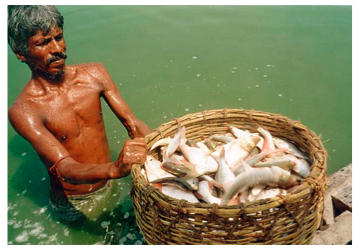
In Calcutta, they've been culturing fish protein from sewage for about 100 years. Basically, they let the sewage flow into a shallow pond, where it causes an algae bloom. Apparently, this clears the water of human pathogens. Then, after a delay for re-aeration, the pond is stocked with fish like carp and tilipia. Systems like this can yield 2.8 metric tons of fish per hectare, per year. The "feed" is human and animal waste. See: Sewage Fed Aquaculture Systems of Kolkata: A Century-old Innovation of Farmers(pdf).

Fish from Shit


Open channel through which sewage is flown.
Lush growth of Colocasia seen on either side of the channel


From another article on shit-based fish culture:
Cities consume resources and produce both liquid and solid waste. The disposal of these wastes is increasingly becoming a problem. However, waste must be regarded as a resource for the sustainable urban development. Agriculture has always been an intrinsic part of Asian cities. In many Asian cities, the composting of separated solid waste and recycling of waste and sewage water used to be a tradition. These conventional methods are being renewed as urban agriculture is found to be providing employment, food and nutrition, land management and environmental improvement.

Kolkata (formerly Calcutta) has one of the largest recycling zones in India with age-old practices of fish culture and vegetable production. A large number of sewage-wastewater-fed fisheries have been developed on the wetlands in lagoon types of ponds in which fish are cultivated, and where sunlight, water hyacinths and phytoplankton are used to clean the water.Source.

Friday, December 07, 2007

319. NON-MECHANIZED AGRICULTURE

The classic doomer soundbite: Peak oil will cause a massive worldwide die-off because modern agriculture is utterly dependent on oil for fertilizers, pesticides, agricultural machinery and transport.

Admittedly, it's a great soundbite. Very scary and plausible if you take it at face value. But -- to quote Baudrillard -- no truth can withstand being verified, and this truth is no exception. It falls apart under pressure. As we have seen:
Part of the power of the soundbite derives from the image it conjures in the mind. When the peak oilers say "agriculture is utterly dependent on oil", I bet you imagine something like this:

Heavy machinery spewing diesel exhaust. The big harvester-combine, mowing through the fields, blowing a stream of kernels into a transport truck. The operation definitely is oil-intensive. But there are ways of massaging that problem too, although I won't go into them today.

Today, I want to focus on another face of agriculture, one we are all familiar with, although we tend to forget when worrying about our "utter dependence on oil". It looks like this:


Remember these people? Yes, of course you do. In the U.S., they're called migrant farm workers, or illegal immigrants. It makes you wonder: Why does the U.S. need so many of them if their agriculture is utterly dependent on oil (i.e. mechanization)?

It turns out that, aside from grains (wheat, rice, corn), most of the fresh food you get at the supermarket is processed/harvested by human hands, not oil-burning heavy machinery.

The Center for Immigration Studies has compiled some interesting USDA-NASS stats on this phenomenon. In 1997, for example,
  • 2,775 farms covering 203,000 acres produced 7.5 billion lbs. of head lettuce at a rate of 50 man-hours/acre using 11,000 harvest workers.
  • 22,805 farms covering 236,000 acres produced 2.4 billion lbs. of fresh sweet corn at a rate of 30 man-hours/acre using 15,000 harvest workers.
  • 28,100 farms covering 454,000 acres produced 10.2 billion lbs. of apples at a rate of 50 man-hours/acre using 57,000 harvest workers
Check the stats for yourself. It's clear that many, if not most, fruit and vegetable crops have only a minor dependence on fossil fuel because most of the field work is done by people, not engines.

You could say the same thing for many meat and dairy products as well. Do you recognize this scene?:
Not much oil being consumed there. We certainly aren't mowing chickens into chicken parts with big oil-fueled combines. In fact, aside from transport and the oil inputs to chicken feed, most of the work on chickens is done in electric factories, or by human hand.

This is a fertile area of inquiry, and I've only scratched the surface. The take-home message: There are two segments of the modern agricultural system -- foods which are highly dependent on oil-powered machinery, and foods which aren't.
by JD

Friday, November 25, 2005

173. WHAT'S YOUR FAVORITE DOOMER SITE?

Peak oil doomer sites have sprouted like mushrooms all over the internet, and I think it's high time they had their own awards show. LATOC is just the tip of the iceberg. We've yet to grasp the true breadth and depth of all the great stuff out there.

Here's my nomination:

http://www.3k88.com/links.htm
Gotta love that Prepare to Survive The Suffering catch phrase.
And of course, what would a doomer site be without the obligatory reference to fertilizer made from oil. Check out the link to "products made from oil", and sure enough, there it is filed under F: fertilizer.

Here's some great doomer copy:
Nations will begin fighting (have begun fighting) for oil and natural gas to save their economies. As people are unable to pay higher prices for manufactured products, employers will begin layoffs and unemployment will increase. The unemployed will not be able to buy, and businesses will close creating more layoffs and homelessness. Protests, riots, and crime will increase and the response will be martial law, a police state, and government seizure of weapons, foods, and medicines for emergency relief and control. All of the efforts to control and protect remaining resources will ultimately fail. This spiral of war, failing businesses, and social decay will get worse in all nations as oil and natural gas resources are depleted.

And of course, the de rigueur Warning!!
Warning:
The following may be very traumatic to think about. We will need all our strength and courage to deal with the consequences of what "peak oil" means. We can handle the truth and we have the right to know what the most frightening and challenging issue is that we are facing in the world. Knowing what difficulties are in front of us is the first step in choosing for ourselves how we will react. If this is the first time for you to learn about the worlds energy situation (oil and natural gas) then you will need some time to think about these coming events, and more time to do your own research to fully satisfy your mind and affirm your ability to get through the difficult times ahead. If you are not ready for this now you can come back later. EXIT
I was kind of bummed out when the "EXIT" button at the end didn't take me to disney.com, so we'll have to dock a few points there.
-- by JD

Wednesday, September 07, 2005

84. MORE ON THE GREEN REVOLUTION

As I've noted before, the "Green Revolution" is the linchpin in the peak oil die-off argument. In short, the idea is this: Humans discovered oil, and by using oil in agriculture (fertilizers, pesticides, mechanization, transport) were able to boost food production above what is possible without oil. This allowed people to, in a sense, "eat oil" -- which in turn caused the population to bloom and overshoot the carrying capacity of the earth. Therefore, when oil gets scarce after peak oil, 4 or 5 billion people will have to die to bring the system back into balance.

This argument is as full of holes as a piece of swiss cheese (as I have pointed out in earlier articles -- see #15, #22, #28, #46, #48, #55, #72, #76), but here I would like to point out one more error: the claim that Green Revolution-style mechanized, monocropped agriculture produces the most food per acre. This claim is demonstrably false, and is in fact a myth propagated by the PR departments of multinational agriculture companies like Monsanto.

Numerous studies show that chemical inputs do not increase crop yields. Here are two examples:
One of the longest running agricultural trials on record (more than 150 years) is the Broadbalk experiment at the Rothamsted Experimental Station in the United Kingdom. The trials compare a manure based fertilizer farming system (but not certified organic) to a synthetic chemical fertilizer farming system. Wheat yields are shown to be on average slightly higher in the organically fertilized plots (3.45 tones/hectare) than the plots receiving chemical fertilizers (3.40 tones/hectare).Source
-------
A comprehensive review of a large number of comparison studies of grain and soybean production conduct by six Midwestern universities since 1978 found that in all of these studies organic production was equivalent to, and in many cases better than, conventional (Welsh, 1999). Organic systems had higher yields than conventional systems which featured continuous crop production (no rotations) and equal or lower yields in conventional systems that included crop rotations. In the drier climates such as the Great Plains, organic systems had higher yields, as they tend to be better during droughts than conventional systems. In one such study in South Dakota for the period 1986-1992, the average yields of soybeans were 29.6 bushels/acre and 28.6 bushels/acre in the organic and conventional systems respectively. In the same study, average spring wheat yields were 41.5 bushels/acre and 39.5 bushels/acre in the organic and conventional systems respectively.(Source: same as above)
More data on such experiments can be found here:
Moving Towards Eco-Farming
What is efficient agriculture?
The Seven Deadly Myths of Industrial Agriculture: Myth Four -- Industrial Agriculture is Efficient

*****
Another myth is that Monsanto/Cargill-style monster farms produce the most food per acre:
The emphasis on small-scale family farms has the potential to revitalize rural areas and their economies. Counter to the widely held belief that industrial agriculture is more efficient and productive, small farms produce far more per acre than large farms. Industrial agriculture relies heavily on monocultures, the planting of a single crop throughout the farm, because they simplify management and allow the use of heavy machinery. Larger farms in the third world also tend to grow export luxury crops instead of providing staple foods to their growing population. Small farmers, especially in the Third World have integrated farming systems where they plant a variety of crops maximizing the use of their land.

They are also more likely to have livestock on their farm, which provides a variety of animal products to the local economy and manure for improving soil fertility. In such farms, though the yield per acre of a single crop might be lower than a large farm, total production per acre of all the crops and various animal products is much higher than large conventional farms (Rosset, 1999). Figure 1 shows the relationship between total production per unit area to farm size in 15 countries. In all cases, the smaller farms are much more productive per unit area— 200 to 1000 percent higher — than larger ones (Rosset, 1999).(Source: same as above)
------
Government studies underscore this "inverse relationship." According to a 1992 U.S. Agricultural Census report, relatively smaller farm sizes are 2 to 10 times more productive per unit acre than larger ones. The smallest farms surveyed in the study, those of 27 acres or less, are more than ten times as productive (in dollar output per acre) than large farms (6,000 acres or more), and extremely small farms (4 acres or less) can be over a hundred times as productive.Source
The data shows that farm size is the critical factor. Man-hour intensive farming can compensate for the loss of fossil inputs, and increase food output beyond what it is now. Extremely small farms (4 acres are less) are 2 to 100 times more productive than large farms. Thus it is clear we can massively increase carrying capacity and total food production simply by decreasing farm size.

The above facts make me wonder if the mechanized/chemical farming industry is similar to the automobile industry. We don't really need the machines/chemicals, and that's why the makers push them with such an aggressive hard sell. It's a lot like cars; you don't actually need them, but the big automakers help rig the system to make you need them, and then they spend millions of dollars on PR to pump out the message: "Can't live without a car." Similarly, you don't need the chemicals, so the chemical manufacturers have really robust PR departments, and employ sophisticated media shills to pump out the message "Without chemicals, we'll all die." The peak-oil doomers have (as usual) bought into this corporate brainwashing.
--------
*) Thanks to oiless for the links.

Saturday, April 26, 2008

350. IS THE CURRENT FOOD CRISIS DUE TO PEAK OIL?

ANSWER: No.

True to form, the peak oil doomsquad can barely conceal its glee at the recent food riots. Like our old buddy Jack from peakoil.com, who is now sporting this nifty new sig:
Dieoff - fun to watch, better with hot buttered popcorn.
Some of these bottomfeeders are now trying to pretend that they predicted the food crisis. Who are they trying to kid? We all know what they predicted. They said oil would peak, and the resulting price rise would cause food prices to skyrocket due to the dependence of modern agriculture on oil for machinery, transport and fertilizer. To paraphrase Colin Campbell and Richard Heinberg: The world population rose with oil, and will decline with oil, back to pre-oil numbers.

So, is that what's happening?

Definitely not.

First, world oil production isn't even dropping. The price of rice began to skyrocket in January of this year, when crude oil production was setting a new all-time record.

Second, although high food prices do have a small oil price component, there are clearly many more factors in play than just oil prices, and all informed commentators recognize this:
"The UN's special rapporteur on the right to food, Jean Ziegler, earlier blamed the [food] crisis on biofuels, speculation on commodities markets, and EU export subsidies."Source
And:
"A freakish cocktail of factors, including poor global crop yields, increased demand from the likes of China and India, and a weak U.S. dollar have made food prices soar. Yet many farmers and commodities buyers suggested yesterday that another factor has exacerbated these price increases, and incited unpredictable gyrations in the futures market: the growing clout of financial speculators, like large index funds and hedge funds."Source
It's gotten so bad that the CFTC (Commodities Futures Trading Association -- the agency which regulates futures exchanges in the U.S.) had to convene a conference last week to address irate farmers complaining not about the surge of diesel prices, but about the surge in speculative money causing havoc in the futures markets. Havoc to a degree that farmers are having trouble marketing their product.

Prof. James Hamilton of Econbrowser also finds the feverish activity since the beginning of 2008 suspect. Regarding the current price surge, he writes:
It seems to me we should be looking for a single explanation behind the common behavior of the group, rather than try to develop a separate theory for aluminum, barley, coffee, cocoa, copper, corn, cotton, gold, lead, oats, oil, silver, tin, and wheat.
Indeed, it seems very unlikely that we are suddenly running out of everything at the same time. He continues:
I also find it implausible to attribute the commodity price increase to a surge in demand. The economic news over the last three months has been very convincing that output is slowing, not accelerating.
In other words, much of the price surge since Jan. 2008 is a financial phenomenon, driven by the Fed's rapid interest rate cuts. This has created negative real interest rates, causing people to flee to commodities in order to preserve value. It's the same conditions which led the Hunt Brothers to hoard silver in the 1970s. If history is a guide, the bubble will pop when the Fed pulls the trigger, and begins to raise interest rates.

Another big factor, particularly in the case of rice, is plain panic, and the hoarding induced by it.

Yes, the price of food has risen, and poses a threat to the well-being of the world's poorest people. Does this mean the doomer shitheads get to say "told you so", break out the party horns, and prematurely ejaculate on their gold hoards and nitropacked food supplies?

Well, they're probably going to do that anyway, but back here in reality... No. There isn't a die-off until the people actually die.

The current food crisis is not the die-off for a number of reasons. First of all, the currently hungry people don't need to die. They're hungry due to lack of money, and there is certainly enough money in the world to get them fed. Dog and Cat food sales in the U.S. in 2005 were $14.3 billion Source , about 20 times more money than the paltry $700 million the World Food Program now needs to address the emergency needs created by the current food crisis.

A die-off, in the strict biological sense, occurs when the environment cannot physically produce enough food to sustain the population of the species in question. Therefore, even if 100 million people starve to death due to the current crisis, it won't be a die-off. Because it is patently obvious that we can feed those people if we want to. Therefore, if they are allowed to die, it would have to be labeled as what it really is -- a "let them die off"" or "kill off" or "mass murder", not a die-off.

Furthermore, there is a whole laundry list of things which can be done to improve the situation. For starters, we can get serious, and shut down the corn ethanol scam. Beyond that, this article (and the related links, all well worth reading) in the latest Economist discuss some of the deeper structural changes which will be needed to keep everyone fed.

Also, it's not at all clear that the current situation will be bad in the long run. Low agricultural prices have caused a lot of poverty in the past, and high food prices aren't all bad -- they bring greater prosperity to farmers and the countryside in developing countries. Only time can tell whether the current situation is a catastrophe or an opportunity.
by JD

Monday, December 10, 2007

320. ELECTRIC TRUCKS

Over the last few weeks, I've shown that the peak oil threat to the food system is greatly exaggerated. Fertilizer can be made without fossil fuel (#314), pesticides can be made with natural gas, coal or bitumen (#48), agricultural machinery can be driven with electricity (#317) , and a large part of the food system (fruits, vegetables, meats) depends more on human labor than oil-fueled machinery ( #319). But this still leaves the all-important question of transport. Can food be transported electrically? The answer is yes.

First of all, it can be transported by electric train:

Numerous electric rail-lines already exist between large cities throughout the world, and busy diesel lines can be electrified with off-the-shelf technology. This is probably the best method for high-volume, long-distance transport.

What about local delivery, within a city? This is the interesting part. Electric trucks are starting to catch on. In January 2007, the British express/mail company TNT began testing "Newton" electric trucks made by Smith Electric Vehicles. These are 7-ton trucks, with a 130 mile range, top speed of 50mph, regenerative braking, faster acceleration from 0-30 than diesel, 15,800lbs payload capacity, and "Zebra" 278v Sodium Nickel Chloride batteries:

Interestingly, these vehicles were developed as "green" zero-emission vehicles, not for peak oil. Nevertheless, they are a great response to peak oil, and show that in-city transport (and commercial/maintenance vehicles) can be electrified. TNT was so impressed by tests of the Newton, that they cut testing short and ordered 50 of them in April 2007.Source And just this month, Smith announced plans to build a 10,000 truck/year facility to supply the U.S. market. Jim Fraser from the Energy Blog reports that:
Kevin Harkins, Sales Director for Smith Electric Vehicles, stated that although automobile manufacturers believe that battery technology for mass-produced electric cars is some years away, Smith believes that for larger sized commercial vehicles the technology available today is perfectly suited.

Smith Electric already has a 70,000sq ft facility in Fresno, CA, which has the capacity to produce 1,000 vehicles next year. It plans on establishing a major production facilIty in the U.S. with the capacity to produce up to 10,000 electicric vehicles per year by 2010. Source
Domino's Pizza and UPS are using Zap cars and trucks for deliveries at the tail of their distribution chains. Source

Here's a video of the Zap trucks working for UPS:


Finally, we have the next big thing in heavy trucking, the hybrid semi, brought to you by the Peak Oil's favorite retailer Walmart:


Peterbilt is also developing hybrid heavy-duty vehicles of other types:


And here's another cool species, the electric sport utility truck, developed by Phoenix Motorcars for commercial/fleet use:
The specs of this unit are amazing: top speed 95mph with 4 passengers and cargo, 100+ miles per charge, 0 to 60 in 10 sec., 250,000 mile battery pack life, 10 min. recharge to 95% capacity.

There doesn't seem to be any technical or economic impediment to electrifying suburban delivery and commercial vehicles in the U.S. In fact, there seems to be a strong incentive. It may be that EVs first make inroads into large vehicles (trucks) and small vehicles (scooters), and only later penetrate into midsize vehicles (cars).

by JD

Saturday, April 15, 2006

286. COAL AND THE EROEI OF CORN ETHANOL

The EROEI of corn (maize) ethanol is one of the "hot button" issues of peak oil, and a source of endless debate. On one side, you've got the partisans of David Pimental who say corn ethanol has an EROEI less than 1, and thus takes more energy to make than it actually contains. On the other side, you've got folks citing a variety studies showing Pimental to be in error.

This debate crops up again and again, and in fact, we had a little outbreak in the comments of this blog the other day.

The topic is boring in the extreme, and guaranteed to give you a migraine headache, so let's save ourselves a lot of time and misery by short-circuiting the entire fruitless argument.

My thesis: The poor EROEI of corn ethanol doesn't matter if you use a cheap, non-liquid form of energy (like coal) to do the distilling and synthesize the fertilizer etc. If you proceed that way, then ethanol can be regarded as a form of "coal liquefaction", and the low EROEI doesn't matter. The question is whether coal liquefaction via ethanol is more cost effective than coal liquefaction via other routes.

It turns out that this is exactly where the future of corn ethanol is going -- a fact I learned from Robert Rapier. Robert is a chemical engineer working in the oil industry, and has an outstanding new blog (R-SQUARED) which I will be adding to the POD sidebar. He is definitely the source to turn to for the best information on biofuels. In a great post on the future of grain ethanol, he describes a number of work-arounds for low EROEI and covers the coal strategy:
The final option is one that most environmentalists probably will not embrace. However, it is the one most likely to take place in the short-term. The natural gas input into ethanol production is a serious long-term threat to economic viability. Since natural gas is a fossil fuel, and supplies are diminishing, it will put upward pressure on the price of ethanol over time. However, if the energy inputs could be produced from coal, ethanol prices would be insulated from escalating natural gas prices. This might also end the EROI debate. I have heard the argument go something like this. "If I have 1 BTU of coal, who cares if I only get back 0.8 BTUs of ethanol? I converted the BTUs into a readily usable liquid form." This argument may be valid from both an economic and EROI point of view, but it ignores the fact that coal is still an inherently dirty energy source. If coal remains abundant and cheap, coal economics will beat natural gas economics, but coal will increase the rate at which we put carbon dioxide into the atmosphere. If we come up with a viable method of sequestering the carbon dioxide produced at the power plant, then we might finally have a viable economic solution (although we are still using up a non-sustainable fuel in the process).Source
Robert also happened to find this article from the Christian Science Monitor which describes how coal-based ethanol is catching on in Iowa. From the article:
Late last year in Goldfield, Iowa, a refinery began pumping out a stream of ethanol, which supporters call the clean, renewable fuel of the future.

There's just one twist: The plant is burning 300 tons of coal a day to turn corn into ethanol - the first US plant of its kind to use coal instead of cleaner natural gas.

An hour south of Goldfield, another coal-fired ethanol plant is under construction in Nevada, Iowa. At least three other such refineries are being built in Montana, North Dakota, and Minnesota.Source
Cleaner options in the same vein include using nuclear or solar process heat.
-- by JD

Sunday, October 02, 2005

121. HYDROPONICS

Hydroponics is the science of growing plants without soil by bathing their roots in a nutrient solution. It holds great promise of increasing the carrying capacity of the earth, and reducing the footprint of human agriculture. This is because:
  1. Hydroponics eliminates the need for soil and the labor involved in soil building and care.
  2. It greatly reduces the need for pesticides since many pests can simply be quarantined out of the structure.
  3. It requires extremely low levels of water and fertilizer use compared to conventional agriculture.
  4. It enables massive increases in yield per acre.
Today, tomatoes are at the leading edge in hydroponic agriculture:
Average U.S. yields for greenhouse tomatoes (which includes both hydroponics and soil-based forms of controlled environment agriculture) are 484 metric tons/hectare. Average U.S. yields for field tomatoes, on the other hand, are 32 metric tons/hectare (Source(pdf, P. 4)). "By providing all the plant's nutrients via hydroponics and regulating the environment, yields can be very high, as much as 15 times greater than field production per year"(Source: same as above, P. 69).

This is not a hypothetical technology. Greenhouse tomatoes are a real-world industry:
In 2003, in the United States and Mexico, the greenhouse shares of total fresh tomato production were 9 and 8 percent, respectively, but are likely higher now. In Canada, greenhouse tomatoes now completely dominate fresh tomato production, with an 89-percent share.(Source: same as above, P. v)
California has even gone so far as to legally define a greenhouse tomato as hydroponically-grown:
In September 2004, the State of California adopted a definition requiring tomatoes labeled as greenhouse to be grown in "a fixed steel structure using irrigation and climate control, in an artificial medium that substitutes for soil" This means that any tomatoes labeled as greenhouse and marketed in California must be grown hydroponically.(Source: same as above P. 6)

Saturday, September 03, 2005

76. THE GREEN REVOLUTION NEVER CAME TO AFRICA

The Green Revolution is a critical linchpin in the peak oil die-off theory; it is what connects food and oil. The idea is that the Green Revolution used fossil fuels (fertilizer, pesticide, mechanization, transport) to increase agricultural productivity, and this increased productivity is what allowed the world population to overshoot the earth's carrying capacity. Without the "phantom carrying capacity" provided by oil, mass die-off would have happened decades ago.

Africa poses a big problem for this theory. For one thing, Africa's population is growing quickly:
Population in Africa has more than doubled since 1970, and is growing around 2.7% per year (the fastest growth in the world).Source
And yet Africa (outside of North Africa, Nigeria and South Africa) uses almost no fossil fuels at all. According to the 2004 BP Statistical Review, the entire continent of Africa (excluding Algeria, South Africa and Egypt) uses only 1.3mbd (million barrels per day), i.e. about 1/8th the amount the U.S. alone uses every day just to fuel cars. So it is clear that fossil fuel did not cause, and does not support, the rapid growth of African population.

Furthermore, it turns out that the Green Revolution started in Mexico, and spread to India, Pakistan and China, but it never got to Africa:
The failure of Africa's Green Revolution

The failure to introduce the Green Revolution on a large scale in Africa
in the 1960s and 1970s is due to a several factors.
Firstly, rice, maize and wheat were the predominant Green Revolution crops, of which only maize is a principal staple food in some African countries. In general, African diets are based primarily on grains such as millet and sorghum or on roots and tubers such as cassava, yams and sweet potatoes. These crops have never received much attention from scientists and were no part of the Green Revolution.
Secondly, much of the African continent has infertile soils, severe pest and disease problems and little water available for agriculture. The use of a narrow genetic base variety and practise of monoculture, all characteristics of the Green Revolution, increases the risks of large areas of crops being devastated by pests, diseases and crop failure. In West Africa, for example, disease and pest problems have hindered a successful introduction of improved Indian sorghum and millet varieties. Water control problems have prevented the introduction of high-yielding dwarf rice varieties. Only 3 to 5 per cent of Africa's cultivated areas are irrigated, compared to 20 per cent of India's cropland. After 10 years of experimenting, only 2 imported rice varieties out of 2,000 tested performed as well as local varieties. Additionally, some of the newly introduced varieties were not easily accepted by local people who preferred the traditional varieties.
Thirdly, Africa's poor transportation and commercial infrastructure makes inputs not easily accessible by all farmers, and harvests can not get to the markets on time. Recent experiences from a project in Ghana, supported by the Sasakawa Africa Association, headed by Norman Borlaug, have shown that high increases in agricultural output can be achieved. According to Borlaug, the main problems are how to ensue that fertilizers reach the farmers and how to bring their produce to the urban markets.
In India and Mexico, unlike many African countries, appropriate investments in rural roads were undertaken by governments with assistance from international donor organizations. The assistance of the donor organizations, notably the Rockefeller Foundation and the Ford Foundation, was predominantly directed towards the areas which were important to the US interests. Africa, historically linked more to Europe than to the USA, therefore had no priority.
Fourthly, many African countries have a lower labour/land ratio, less human and institutional capacity, and have economic limitations. While many Latin American and Asian countries have large economies, the many African economies are small and even more dependent on the export of primary commodities. Besides, their open economies are more susceptible to fluctuations in international prices. Government revenues and, consequently, agricultural research budgets, depend mainly on export earnings and are highly unstable as a result. Prior investments in human capital and development of training and research institutions by the Green Revolution countries of Asia and Latin America contributed to their success in agricultural research. India, for example, began to build agricultural colleges in the 1920s under the British colonial government. By the 1960s Indian policy makers and scientists had acquired extensive knowledge about the nature of problems facing agriculture in that country, about where the biggest pay­offs of research would likely be, and about which parts of the country had the largest agricultural potential.
In contrast, many African countries have, until recently, devoted little investment to the training of agricultural scientists or building research institutions. The lack of trained personnel and knowledge of local agricultural conditions severely limits the effectiveness of foreign assistance and places too much reliance on expatriates.
African countries have, compared to India, not such a strong agricultural policy. India's state advisory services have been much more geared to serve not only the large­scale but also the small-scale farmers, who make up the majority of the rural population in many developing countries.Source

The argument that die-off will occur due to a failure of oil-based Green Revolution agriculture does not apply to rural Africa.