free html hit counter Peak Oil Debunked

Friday, June 20, 2008

363. PEAK DEMAND

Lots of recent signs that we are hitting peak demand (with a salute to our wise and prescient friend, Benny "peak demand" Cole ;-)...

The US Department of Transportation reports that vehicle miles traveled (VMT) has begun its terminal decline:
The FHWA's “Traffic Volume Trends” report, produced monthly since 1942, shows that estimated vehicle miles traveled (VMT) on all U.S. public roads for March 2008 fell 4.3 percent as compared with March 2007 travel. This is the first time estimated March travel on public roads fell since 1979. At 11 billion miles less in March 2008 than in the previous March, this is the sharpest yearly drop for any month in FHWA history.Source
Here's the graph:

As you can see we're having a "Hubbert Peak" in demand.

Meanwhile CERA is reporting peak demand for gasoline:
Gasoline demand in the United States may have reached its peak, as rising prices lead consumers to make long-term decisions that will weaken demand in the years to come, according to a new analysis by Cambridge Energy Research Associates (CERA), an IHS Inc. (NYSE: IHS) company.

The report, Drivers Turn the Corner in the United States, conducted by CERA’s global oil service predicts that U.S. gasoline demand will likely decline in 2008 for the first time in 17 years. If petroleum prices stay at or near their current levels, 2007 could prove to have been the peak year for U.S. gasoline demand.

"Americans are now driving less and demanding greater fuel efficiency from their vehicles when they do drive," said Aaron Brady, CERA director, global oil. "Automakers are responding by accelerating the shift in their model mix. Both short- and long-term signals are all pointing toward decreasing future demand."Source
MasterCard reports a big drop in U.S. gas sales:
During the week leading up to the Memorial Day holiday, the traditional start of vacation season, Americans pumped 5.5 percent less gasoline than a year ago as average prices hit a peak $3.84 a gallon, MasterCard Advisors said in a report.Source
Demand in the UK is sagging:
Gasoline demand in Britain dropped 7 percent below year-ago levels in April, with diesel use down almost 2 percent, according to government figures released on Wednesday.Source
Gasoline demand in Japan has declined for the last two years:
Japan's Ministry of Economy, Trade and Industry reported on Thursday that gasoline demand declined for a second year in 2007 on rising oil prices, urging refiners to export record amounts of fuel.

Sales of gasoline slipped 1.7% to 59.8 million kiloliters in 2007, while exports of all refined oil-products climbed 27% to 28 million kiloliters, exceeding the prior record of 22.3 million kiloliters posted in 1975.Source
And the trend is continuing. The most recent May 13 Oil Market Report from the IEA reports (P. 6) gasoline demand for March 2008 down (year-on-year) by -8% in Germany, -4% in the UK, -14% in France, -10% in Italy, -9% in Spain and -14% in Japan. Similarly, diesel was down -4% in Germany, -6% in France, -4% in Italy, -10% in Spain and -10% in Japan. And those are the figures for March, before oil prices really went vertical.

Anyway, lots of good news. The fear factor of peak oil drops considerably if demand peaks before oil does.
-- by JD

Monday, November 07, 2005

154. CHINDIA SAVES US FROM PEAK OIL

It's very unlikely that Peak Oil will sneak up on us unawares. Actually, the evidence suggests the opposite – that Peak Oil will be preceded by plenty of signals in the form of high prices and disruptions, and that we'll actually be well-prepared by the time it comes around.

Why? Well, the main reason is the increasing demand from China and India (Chindia), which would cause price rises whether there was a geological problem or not.

Here's a quote by Stephen Leeb, president of Leeb Capital Management and author of The Oil Factor:
As China and India become rich nations, the demand for oil could grow at 6% per year, compared to 2% recently. Currently, the world has almost no excess supply. The planet is operating at anywhere from 95% to 99% capacity, Leen says. “There is no margin for error.” The only way the system can respond is continued price increases. Source
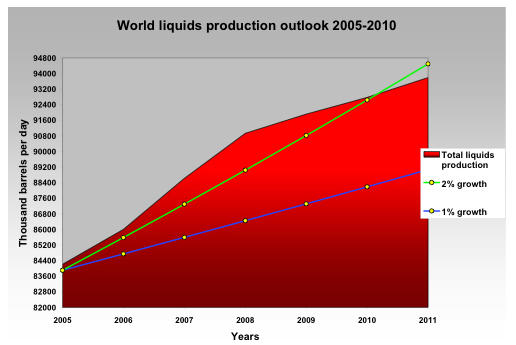
Now let's add geological factors to the equation. JD has already shown (in posts no. 53 & 86) that oil is unlikely to peak before 2010. This is the estimate made by Rembrandt Koppelaar by adding up projects scheduled to come on stream all over the world. On top of this, Koppelaar predicts that before the supply itself begins to decrease (Peak Oil), the rate of additions to supply will gradually slow – as attested to by the small margin for error in the current system. Note that if demand growth slows to 1% because of higher prices, a surplus remains even after the geological peak:
Source: Koppelaar Report(pdf)


So you've got yourself a double whammy:

1. Demand is increasing at a faster rate
2. Supply is increasing at a slower rate

When demand increases at a faster rate than supply, prices go up. How far up?

Here's a report(pdf) from the Canadian Imperial Bank of Commerce:
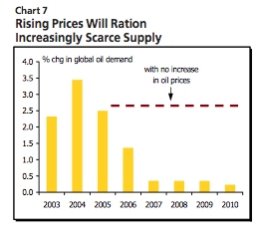
As a rough guide to estimating the price needed to confine demand to available supply, we have used an elasticity of 0.15 for global oil use. A 0.15 elasticity means that a 10% rise in crude prices lowers crude demand by only 1.5%. Taking today's roughly $55/bbl price as the benchmark, crude prices must rise to an average $61/bbl next year and to an average of $70/bbl by 2007 to achieve the needed demand cuts from trend. As those cuts begin to mushroom after 2007, so too must the price hikes required to bring them about. Crude prices need to rise to an average $80/bbl in 2008 and continue to rise to $101/bbl by 2010 (Chart 8). In constant dollars, those prices would represent the highest the world has paid for oil since the second OPEC oil shock, some forty years ago.
Here's their forecast:


In other words, by the time that Peak Oil comes around in 2011, we will have had six years of continually increasing prices. This doesn't mean we're completely out of the woods, but it will slow India and China's demand growth, make tarsands and liquefied coal cost-competitive with oil, and give us plenty of time to build tramlines, adjust the economy and get back on our bicycles. The reduced global demand may also push the Peak back several years, and after that we may experience a similar plateau on the downslope (note that this is all consistent with the idea of a bell curve which flattens on either side of the Peak).

Barring a terrorist attack on a pipeline or massive embargo from Saudi Arabia, sudden supply shortages are just not going to happen. If these figures are true, the only way that a country could just crash into a peak unawares is if it started nicking other people's oil and raiding its own reserves. This appears to be exactly what George Bush is trying to do: preserving the American way of life with a few more years of cheap oil while leaving the real problems until someone else is president. Fortunately it isn't working, and politicians will just have to come clean that they can't do anything about oil prices.

So to sum up:
1) If Koppelaar and Leeb are right, then high prices will prepare us for a Peak long before there is an actual shortage.
2) If Colin Campbell's right, Peak Oil already happened in 2004 and nobody noticed. Which is even better.
3) If the cornucopians are right, Peak Oil won't happen until 2030, by which time we'll have fusion-powered personal spaceplanes and live on the moon. Which is better still.
-- by Roland

Tuesday, April 25, 2006

294. WILL A SUPERSPIKE MODERATE DEMAND?

In the peak oil community as a whole it is becoming ever clearer that an enormous amount of technological & sociological options are there to provide us with a sustainable world. The discussion of what level of welfare can be achieved with these options is still ongoing. Everyone that has studied the peak oil issue knows that a large change has to happen to make this a sustainable world, no matter what level of welfare we are talking about.

I think oil prices can be a great help in forcing this change. Only in times of need can the radical changes and re-doing that is necessary take place. The question we need to ask to understand this process is how the oil market will develop. Until now the peak oil crowd has mostly looked at production scenarios from the supply side. Next week on the 27th of April I will discuss future oil price predictions at a conference of the Dutch University of Tilburg. In my presentation I have included the following chart:


What we see in the chart above is the Regular scenario that I made in the Peak Oil Netherlands World Oil Production & Peaking Outlook of 2005 (peak in 2012). This was based on a bottom-up oil projects analysis which has now proven to be slightly on the optimistic side. The actual production at the end of 2005 has been roughly 600.000 barrels per day lower than what I expected. The preliminary conclusion that we can draw from this is that the decline in the world as a whole is somewhat larger, more in the vein of ExxonMobil’s 4% to 6% than Shell’s 2% - 3%. Another option is that geopolitical forces and project slippage are quite big (even the disruptive scenario which tried to account for these factors was a little bit too optimistic).

In any case, should we be worried about this outcome for 2005? That depends on your viewpoint. The second scenario in the chart above, demand influenced, is trying to integrate demand side responses. At the moment I am not that sure how this will all play out. I strongly believe that we are in what Goldman Sachs calls the “superspike” period. Oil prices will go through the roof (100+ dollars) in the coming years due to supply constraints on the geological side but also the investment and refining side. According to the oil project analysis there is enough oil out there to postpone a peak until at least 2010. I realize that this is still under debate, but for the scope of this article I consider a peak before 2010 quite unlikely.

In the media the current price rise is attributed mainly to demand and geopolitical factors. While this is true, the underlying cause is simply that many more oil countries have peaked as of late. In the past five years, nine countries have peaked so far. In the 10 years before that only eight countries peaked. It is safe to say that the decline rate in the world as a whole is increasing. This is what has truly caused a decline in the spare capacity of the world; the increased demand only increased the problem. The chart below shows the years at which either peak or a decline after the plateau period happened for the stated country.

If we assume that superspike will happen in the coming years how will it influence demand? In the most optimistic case everything goes very smoothly. At a certain supply level demand lowers itself to fit into the constraints of supply. That will cause the oil price to equilibrium out at the level of supply at that time. The price will cause additional investments to take place that could provide more oil to the market. This is the basic outline for the “regular” scenario. On the other hand, will the world be such a smooth place in the zero-spare capacity game we are in at the moment? All eyes are focused at Iran at the moment. What will happen to oil production given the nuclear debate and possible intervention? I consider it quite likely that another oil shock takes place, or multiple smaller ones, triggering “superspike”. In this case the demand influence comes into play. The production level I have presented in my scenario is only instrumental to demonstrate this point; it could very well be that production drops firmly for a while due to such a shock.

If such a shock happens, economies will take a blow like in the 70’s, demand drops to come into equilibrium with the new supply situation. However, there is no fall back cushion from the supply side, only a strategic reserve cushion that could help somewhat. You can imagine that the effects could last for quite some time; oil production is not restored that easily and stays on a plateau level. In the beginning, oil prices of near 200 dollars per barrel are a reality, probably moderating after a few months to a year to around 100 dollars a barrel.

This superspike period will be the time when we all the technological & sociological options will be put to the test. If the will to invest and change doesn’t take place in a longer period with very high oil prices, when will it work? In the most optimistic scenario, oil production just keeps on a plateau until it drops off because demand starts to decrease due to the technological and sociological change. The peak presented in the demand influenced scenario can be scrapped from the chart. And peak oil isn’t all that interesting anymore.

In the more realistic scenario, we still keep on demanding gigantic quantities of oil. Since everyone wants to have more of the stuff huge investments take place in oil production capacity to sell at high prices. After a few years, this investment is translated into higher oil production which may moderate oil prices of around 100 dollars a barrel to a lower level, such as 60 dollars a barrel. Than the last spurt takes place to a peak around the end of the next decade, pumping at full tilt until production starts dropping off sharply. The downside curve in the chart may be too optimistic in this case. In any case the continued high prices will be a breaking point to cause change.

Note:

The demand influenced scenario has not been based on any calculations but on a mental framework. The scenario only serves an instrumental purpose. So do the oil prices mentioned in this article, they are wild guesstimates. The website of the discussion at the University of Tilburg is http://www.internationalconference.nl
-- by Rembrandt Koppelaar (Peak Oil Netherlands Foundation)

Friday, June 25, 2010

427. PEAK OIL SNOOZE-ATHON CONTINUES

Hi everyone.
I've been on a long vacation from peak oil because it's so boring and irrelevant to daily life, but today I'd like to pop back in for an update on the situation.

Has anything happened? Not really, if by "happened" you mean any of the things the doomers predicted.

I first began writing on peak oil 6 years ago, in the summer of 2004. Matt Savinar was predicting imminent TEOTWAWKI, and telling folks to run for the hills. Now, 6 years later, I can go out on the street, and nothing whatsoever has changed since 2004. The streets are still clogged with cars going on mindless journeys. People are sleeping in their cars with the engine running to power the air-conditioning. Oil is at $75 and it's not going anywhere. Food prices and availability are completely normal. Plastic Hello Kitty paraphernalia is as plentiful and cheap as ever. Peak oil continues to be a ridiculously over-hyped non-event, just like I always predicted. I thumb my nose at it with impunity. LOL.

The Oil Drum doesn't even bother with new posts anymore. Just recycled versions of the same old "oil spill" post, flopping over and over like a flat tire, wump wump wump. Quite a comedown from the heady days of A Nosedive Toward the Desert in 2007.

Yup, peak oil is yesterday's party. The IEA is yawning and predicting oversupply of oil until 2015. Lucky us. Five more years of "topics for discussion" from Gail the Actuary
Source

Matt Simmons' ongoing nervous breakdown continues to blossom in fascinating ways. Last week he predicted a mass evacuation of gulf states:
"We're going to have to evacuate the gulf states," said Matt Simmons, founder of Simmons and Co., an oil investment firm and, since the April 20 blowout, the unflagging source of end-of-the-world predictions. "Can you imagine evacuating 20 million people? ... This story is 80 times worse than I thought."Source Yah, that's some funny stuff. I think Matt Simmons is about 80 times more mentally unstable than I thought.

Matt "Bozo" Simmons

More hysterical bullshit from Matt Simmons:
"Mexico's ability to export oil will be over by the end of 2009."
(Spoken prediction made at 35:50 of the interview available here)
The reality:
Mexico exported 1.59 million barrels of crude per day in May 2010.
Source

Speaking of the mentally ill, Mike Ruppert predicted that a nuke would be used on the gulf oil spill in a week to 10 days. That was a month ago. LOL.
"I predict that US Continuity of Government provisions will be activated and that FEMA will, before end of summer, be placed in complete control of the Southeast United States… limited martial law." Source

Colin Campbell, the pope of peak oil, recently caved and became a peak demand believer.

"I have changed my point of view about future prices," said Campbell, who used to think the peak in conventional oil production, which he believes happened in 2005, would lead to a relentless price surge.

Instead, the record rally led to a peak in demand in the developed world.

"Peak oil drives prices up in the first place. It has its own mechanism. We're sort of at peak demand right now," Campbell told Reuters from his home in the village of Ballydehob, West Cork. "I think presently the price limit is about $100."Source

Good job Colin, you ridiculous dumbass. You would have figured that out a long time ago if you had the sense to read Peak Oil Debunked.


Hey, and whatever happened to the much-ballyhooed Export Land Model (insert scary organ chords)? And Jeffrey Brown's 2005 prediction:

"As I said last year, I expect that by the end of 2006 we will be in the teeth of a ferocious net oil export crisis."Source

Stay tuned folks. I've got a few more doomers to scalp before I'm finished.
by JD

Wednesday, November 02, 2005

150. "DICK CHENEY" PEAK OILERS

One of the oddest aspects of peak oil is attitudes toward conservation. On the face of it, you would think that peak oilers (i.e. those who are aware of the impending decline in oil production) would be very pro-conservation. And, indeed, this is often the case (Amory Lovins being a good example).

However, as I have debated people about peak oil, I have noticed a surprising thing: many peak oilers are actually anti-conservation. I call these people "Dick Cheney peak oilers" because they essentially have the same view of conservation as Dick Cheney:

"Conservation may be a sign of personal virtue, but it is not a sufficient basis for a sound, comprehensive energy policy."
Generally, peak oil has strong left-wing overtones (environmentalism, resistance to the Iraq War, contempt for Halliburton etc.) So why would peak oilers think like Dick Cheney?

Here's the first reason: Pessimists are committed to the idea of breakdown or collapse, so they fret about supply, like Dave over at the Oil Drum:
Here's the main point: Can anyone, anywhere, point to a large new secure supply of crude coming online anywhere in the next few (5) years that solves the supply and demand equation in that time frame and beyond? I think not.
When the IEA draws some crazy curve which says world demand is going to be 121mbd in 2030, pessimists like Dave really take it to heart. They genuinely think that the world is going to need that much oil. That is why they are pessimistic. The world will need 121mbd, but it's unlikely that amount will be forthcoming, so the system is going to breakdown.

I, on the other hand, am an optimist. I believe that most oil is wasted and conservation is actually quite easy. I don't believe we need most of the oil we are using today, so the failure to meet the 121mbd target is not really a big deal. Like I wrote back to Dave:
The error in your ways is that you are thinking only in terms of supply side solutions. You think that the failure to meet demand is a terrible problem. It's not. Most oil demand is for frivolous, wasteful uses (like single person commuting in the U.S.) It's a form of addiction, and demand destruction isn't a bad thing, it's "healing" or "getting better".

To answer your question: The large new supply of secure crude is going to come from conservation, i.e. U.S. commuters riding two-to-a-car instead of one-to-a-car etc.
I've found from experience that comments like the above really make the pessimists' blood boil. For example, here's a response from EricB:
You make me VERY VERY angry with talk like that.

YOU CANNOT "CONSERVE" WHAT YOU DON'T HAVE.

Conservation is DEAD. Let's call it "adaptation." Adaptation to scarcity. And no one can even pretend to know how this is going to affect a nation like the US that has ignorantly hogged oil for decades.

What you call "waste" is another fool's necessity.
Isn't that interesting? EricB -- a guy who is firmly in the doomer camp -- is talking like Dick Cheney. We can't conserve because we really need the oil.

The fact is: we don't need most of the oil we consume. The oil used to fuel personal automobiles, for example, is totally unnecessary to live (or even to live at a first world standard of living). How do I know this? Because:

a) People lived for millenia without cars.
b) Even today, the vast majority of the people in the world don't have a car, and they aren't dying.
c) Lots of people live a comfortable first-world lifestyle without a car. I happen to be one of them.

So the sound bite "You can't live without a car" needs to be recognized for what it is: corporate brainwashing. Peak oilers who argue that supply shortages will be devastating because we need cars are on the Dick Cheney team. They are unpaid volunteers doing PR work for Halliburton, Exxon and GM.

This topic often turns into a debate about the "housing stock" in the U.S. Even if the pessimists grant that the U.S. doesn't really need the oil (because cars and sprawl are not strictly necessary), they will say it isn't "realistic" for the U.S. conserve because the housing stock is "locked in". Which, of course, sounds just like Dick Cheney. Americans must waste oil because they built their houses way out in the exurbs, and now it's too late. Like Dick Cheney says: "The American way of life is not negotiable."

But let's think about the term "housing stock". What is "housing" anyway? All you really need from housing is a warm place to sleep, some blankets and pillow, a roof over your head, a place to take a crap, and (ideally) running water.

So here's a conservation tip for people out in the exurbs: sleep at your office or workplace during the week, and commute on the weekends. That will reduce your commuting fuel usage by 80%, even with single person commuting.

Of course the pessimists will moan and howl over this one. It pisses them off that I am unmasking the "peak oil problem" for what it really is: a trivial lifestyle issue. Sleeping at the office just isn't "realistic". It's more realistic to think that the overweight American populace will wage bloody riots in the street -- because sleeping at the office a few nights a week is so ridiculously unthinkable. The American way of life is not negotiable, doncha know.
--by JD

Tuesday, August 16, 2005

18. NINE DELAYS FOR PEAK OIL

A lot of people in the peak oil community seem to be rooting for an early collapse of modern society. Here, briefly, are nine factors which will delay that outcome.

1. The delayed peak
Deffeyes, Campbell, Ruppert, Richard "Olduvai" Duncan and Boone Pickens may be wrong in calling for an early peak. For instance, Campbell is calling for a peak in 2006, but he's made a number of incorrect predictions before. None of these people have any exact data on ultimate recoverable reserves (URR), and that uncertainty may cause the actual peak to occur 5, 10, 15 or 20 years later than they predict.

2. Plateau
Even if we hit peak, it may be possible to extend a flat plateau for another 5 or 10 years.

3. Substitutes
Even if oil peaks, this does not mean that other forms of energy will peak. The loss of oil can be compensated by boosting forms of energy which aren't peaking, such as natural gas, coal, sugar cane ethanol, biodiesel, solar etc.

4. Recession
Crude oil prices rise sufficiently to cause global recession, as occurred in the late 1970s. This causes oil consumption to drop dramatically, and stalls off peak oil for another 10 years.

5. Demand destruction
Even if world petroleum production peaks, this does not mean that consumption by wealthy nations will decline. They will keep their flow steady or growing by outbidding poorer nations for the limited supply. The wealthy, powerful nations will hog the oil, and thereby maintain their growth for some time.

6. The slow slope
Common wisdom amongst peak oilers is that world oil production will drop by 3% or more a year post peak, but that's not cast in stone. It may be possible, using technology, substitutes and other delaying tactics, to reduce the decline rate to something more manageable, like 1%. If that can be achieved, the "collapse" will occur at a glacial pace; it would take an entire human lifespan for standards of living to drop to 50% of their previous level. I would imagine that standards of living in the US could drop by 50%, and people could still live quite comfortably. And this does not take into account nations with declining population (like Russia, Japan, Italy, Ukraine, Germany etc.) which can reduce consumption without lowering their standard of living.

7. Conservation
Clearly nations like the US are wasting massive volumes of oil everyday. The effects of the peak can be delayed by another 5 to 15 years by squeezing out all this waste.

8. Technology
It does sound kind of silly to have "faith" in technology. On the other hand, it is just as silly to have no faith whatsoever in technology. We simply can't rule out the possibility that someone will discover a solution (partial or whole) to our energy problems. Many peak oilers seem to think that we have come to the end of energy-related technology breakthroughs, but I find that extremely unlikely. Bizarre and previously unthought of discoveries have always occurred (X-rays, fission, quantum effects, bucky balls, quantum teleportation etc.), why would they stop now? Because we've gotten to the bottom of it?? I doubt it.
Honestly, someone needs to explain that: Why would technological breakthroughs just stop one day? Did the universe run out of secrets? We understand everything now? I find that incredible.

9. Hoarding
Exporters like Russia can stall off peak oil effects in their own countries by not selling their oil. They have more than enough oil to satisfy their own needs (including growth) for decades. If peak oil gets tough, they can stop selling oil, and the peak won't affect them.

------------

You can combine the above factors in the obvious way, and next thing you know, we've pushed any serious effects of peak oil out 35 years into the future. There's a very good chance that we will adapt and develop new approaches to energy/transportation during that time. There is no reason to run for the hills or hoard food and guns in preparation for an imminent peak oil famine.

Thursday, June 26, 2008

364. THE OTHER "PEAK OIL"

We all know the classic image of peak oil. This graph of U.S. production says it all:


The peak oil community is obsessively focused on images like this. Peak graphs are presented for every country, like a slide show, and after viewing the whole series, you're damn lucky if your eyeballs haven't turned white and coagulated from raw anxiety.

But that's just one side of the story. Today I'd like to show you a different series of peak oil graphs -- the ugly stepsisters who don't seem to get any attention. These are the graphs of peak oil consumption. Figures and images come from EIA country profiles. Take a deep breath, and fasten your seatbelt for a rude awakening to the realities of "peak oil".

Figure 2: Japan Oil Consumption Has Been Declining Since 1996


As you can see, "peak oil" occurred in 1996 in Japan -- 12 years ago -- and was an entirely demand-driven phenomenon.

Figure 3: Israel Oil Consumption Has Been Declining Since 2001


Wooh baby, that'll turn your hair white... Israel "went over the cliff" in 2001, and is now down 16% from it's peak level.

Figure 4: Germany Oil Consumption Has Been Declining Since 1998

The decline of Denmark has an interesting dual-peak structure. It's down 34% from its primary peak in 1980, and 20% from its secondary peak in 1996:

Italy peaked in 1995 and is now down 14%:

Savinar says a 10-15% drop will put your economy in the hospital -- shatter the economy and reduce the population to poverty. Apparently Italy didn't get the memo.

Sweden hit its final peak in 1996:


It's such a shame because these graphs hold the important clues about peak oil. Yet they get almost none of the airplay. The fact that oil production will peak is just a truism -- a statement of basic logic. The fact that a country can reduce it's oil consumption without duress is like a miracle... something to really think about and learn from.
by JD

Wednesday, October 19, 2005

137. PEAK OILER DOGMA

-- by Antimatter

The assertion that new technologies, EOR etc only increase production rate but not URR is taken as gospel.

Ditto for the assertion that reserves growth is solely a function of conservative SEC reporting rules in the US.

Chevron does a nice little PR campaign (willyoujoinus.com) - peak oilers say "Chevron says peak oil is here!"

ExxonMobil forecasts that non-OPEC production will peak around 2015. In their forecast, NGLs, tar sands and other unconventional liquids turn this into a plateau and OPEC boosts production resulting in no peak till 2030. Somehow, peak oilers say "ExxonMobil says oil will peak in 2010!!"

The WoodMackenzie report that found some oil companies spent more on exploration than the value of the oil they discovered is often cited. Never mind that that study was based on $20 oil, and a later report from WoodMac showed that at $40 even the poorly performing companies had done very nicely indeed.

Sudden dips in production from country x,y,z are seized upon. Witness the thread a month or so ago entitled "MEXICAN OIL PRODUCTION CRASHES!" when production was shut in due to a hurricane. A similar thread on Norway was started when production fell sharply, complete with much hand wringing. Turns out the official reason, fields shut down for maintainace for longer than expected, was true, and production rebounded a couple of months later. Naturally, this went unnoticed.

Many peak oilers deride economics, then point to the high price of oil as proof that peak is here.

Posts full of errors such as confusing source rocks and reservior rocks are greated with backslapping and approval when they fit the groupthink view.

An OPEC official announces that members are free to produce flat out. This has happened a couple of times at least. Peak oilers freak out and compare it to the Texas Railroad Commisions statement in 1970 allowing producers to pump flat out. This is followed by "the peak is here!!!". The possibility that OPEC may expand capacity is evidently not considered.

Events are taken out of context. For example, Saudi Arabia announces they are doubling their active rig fleet to 110 rigs vs 50 or so. Peak Oilers say "they are desperatly drilling holes as fast as possible to offset exponentially increasing declines". This lacks context. As we speak, 2179 rigs are churning away in North America alone for much lower returns. It should be no suprise that this occurs after they reveal ambitious plans to increase production to meet surging demand, after churning out crude for decades without drilling many new wells.

Every possible piece of news is taken as evidence The Peak Is Here, whilst Campbell/ASPO shifts the peak back (again) to 2010 and Jean Laherrere's liquids peak of 2015 stays steady.

Thursday, April 06, 2006

279. THE MANY WRONG PREDICTIONS OF KEN DEFFEYES

In the interests of honesty and full-disclosure, it's probably best if we take a close look at the numerous failed peak predictions of Professor Kenneth Deffeyes, PhD.

Ken first called the peak for the year 2000. In an article called "Brace yourself for the end of cheap oil" in New Scientist*, Deffeyes had this to say:
And he [Deffeyes] believes the highest single year may already have passed. "2000 may stand as a blip above the curve and be in the Guinness Book of World Records."
Similar remarks are recorded in the ASPO August 2003 newsletter:
This may substantiate the view, voiced by Ken Deffeyes, at the Paris ASPO Meeting [May 2003], that peak oil production may turn out to have been in 2000 as much from falling demand as supply constraints.
This was a huge goof, and seriously calls into question Deffeyes grasp of the situation. According to the EIA, oil production in 2000 was 77mbd, while today it is pushing 85mbd.

Next, in his book "Hubbert's Peak", published in 2001, Deffeyes claimed that "the numbers" showed that peak would occur in 2003, although he admitted the possibility of error, as described in the review of his book in the October 2001 issue of Scientific American:
The numbers pointed to 2003 as the year of peak production, but because estimates of global reserves are inexact, Deffeyes settled on a range from 2004 to 2008. Three things could upset Deffeyes's prediction. One would be the discovery of huge new oil deposits. A second would be the development of drilling technology that could squeeze more oil from known reserves. And a third would be a steep rise in oil prices, which would make it profitable to recover even the most stubbornly buried oil.
Then, in the New Scientist article* referenced earlier, Deffeyes made the following claim:
I am 99 per cent confident that 2004 will be the top of the mathematically smoothed curve of oil production.
This too, turned out wrong. Production kept rising, so Deffeyes swept the old predictions under the carpet, and boldly stated that the peak would occur on Thanksgiving Day (Nov. 24) 2005.

Yet again, his prediction turned out wrong, so he changed his prediction to Dec. 16, 2005.
In the January 2004 Current Events on this web site, I predicted that world oil production would peak on Thanksgiving Day, November 24, 2005. In hindsight, that prediction was in error by three weeks. An update using the 2005 data shows that we passed the peak on December 16, 2005.Source
(This waffle occurred in the same issue of his web newsletter where he claimed that "By 2025, we're going to be back in the Stone Age" -- a claim that he later backpedaled and retracted. See 259. KEN DEFFEYES STARTS BACKPEDALING.)

This still isn't the end of it. Just a few days ago a reader of this blog attended the EGU meeting in Vienna. In a "Great Debate" with Jean Laherrere, Michael Lynch and Yves Mathieu, Deffeyes said that if we consider the uncertainty of his regression line, peak oil can be expected to occur somewhere between Nov. 2005 and April 2006 -- i.e. right now. In other words, he's waffling yet again.

So let's total up the whole sorry scorecard. Deffeyes has predicted that PO would occur in:

2000
2003
2004-2008
2004
Nov. 24 2005
Dec. 16 2005
And now Nov. 2005-April 2006.

No integrity whatsoever. Just a sad old man trying to hang onto the spotlight. Maybe it's time to retire, Ken, and open a waffle shop.

You wanna know the method that Ken is using to predict the peak now? It's fun. Anybody can do it, and it's guaranteed to work -- even if you're a drooling moron with Cheetos in your nostrils.
  1. Buzz over to the EIA site, and see what the current world oil production figure (X) is.
  2. State that X is the peak.
  3. If in fact X does turn out to be the peak, you're Prophet El Supremo.
  4. If oil production subsequently rises, you'll have to "readjust your prediction to take account of new data". Go to step 1.
Deffeyes isn't the only scammer out there playing this game. T. Boone Pickens is running the same con, and making money at it!

“Never again will we pump more than 82 million barrels.”
-- T. Boone Pickens, 9th August 2004. On the Kudlow and Cramer Show, MSNBC.
Source

“Global oil [production] is 84 million barrels [per day]. I don't believe you can get it any more than 84 million barrels."
-- T. Boone Pickens, addressing the 11th National Clean Cities conference in May 2005.
Source

"I don't believe that you can increase the supply beyond 84 or 85 million barrel as day."
-- T. Boone Pickens, on "CNN In the Money", June 25, 2005.
Source

"Supply is—you‘ve just about had it on supply; 85 million barrels a day world supply is about it. "
-- T. Boone Pickens, on Hardball with Chris Matthews, MSNBC, Aug. 26, 2005
Source

------

*) New Scientist vol 179 issue 2406 - 02 August 2003, page 9 -- a copy can be downloaded as a doc file here),
-- by JD

Tuesday, November 29, 2005

177. CROSS-BORDER ISSUES

Paraguay is an interesting case-study in energy issues. According to the DOE and the Oil and Gas Journal, it has no coal, no oil, no natural gas and no nuclear. The country would seem to be a prime candidate for electrical blackouts, but (it turns out) they are not. Paraguay is the joint owner of the largest electrical generating facility in the world, the Itaipu Dam (12.6 Gwatts):

From the DOE:
In 2002, Paraguay consumed 2.5 billion kilowatthours (Bkwh) of electricity, the fourth lowest level of power consumption in South America. Paraguay generates nearly all its electricity from one hydropower plant, Itaipu, which provides about 94% of Paraguay's relatively small electricity demand. The Yacyreta and Acaray hydropower plants, as well as six small thermal-fired plants, supply the remainder of the Paraguay's power demand.

Although Paraguay consumes a relatively small amount of electricity, the country ranks as the fourth largest electricity producer in South America, behind Brazil, Venezuela and Argentina. In 2002, Paraguay generated 48.4 Bkwh, of which 95% was exported, mainly to Brazil. In 2002, Paraguay's net electricity exports of 45.9 Bkwh were the second largest in the world, behind only France.Source
Paraquay is like France, a country with a strong natural advantage in the post-peak period.

But let's compare it with one of its neighbors. Uruguay also has no coal, no gas, no oil, no nuclear. So how are they going to keep the lights on? Primarily with hydro, but beyond that, they're in a bit of trouble. Here's the DOE data on Uruguay:
Generation Facilities
Four hydroelectric facilities provided the bulk of Uruguay's electricity generation in 2004: Terra (0.53 Bkwh), Baygorria (0.40 Bkwh), Palmar (0.98 Bkwh), and Salto Grande (2.85 Bkwh). The remainder of the country's electricity generation comes from thermal power plants, which UTE only calls upon during peak demand, or when weather conditions suppress output from its hydroelectric facilities.

Under normal weather conditions, Uruguay's hydroelectric plants cover the country's electricity demand. However, seasonal variations can leave Uruguay at a severe power deficit, forcing the country to rely upon imports or costly oil- and diesel-fired generators. In 2001, UTE announced a tender for a new, 400-megawatt (MW), natural gas-fired power plant that would help diversify the country's electricity supply. However, a combination of factors forced Uruguay to withdraw the tender in early 2005, including the election of a new president in early 2005, questions regarding the future of natural gas imports from Argentina, the cost of the facility ($200 million), and the construction time (26 months) of the project.Source
The DOE has a link on those "questions regarding the future of natural gas imports for Argentina", and clicking on it, we find this:
Issues Concerning Imports
Due to natural gas shortages, Argentina has recently begun interrupting its natural gas exports to Uruguay and Chile. This has raised concerns in Uruguay about the future security of its natural gas supply and jeopardized plans to increase domestic natural gas consumption. Uruguay has negotiated with Bolivia about building a natural gas pipeline between the two countries as an alternative to Argentine imports.Source
This is just one manifestation of a wider phenomenon.
Monday, November 28, 2005. Page 6.
No More Cheap Gas, Russia Tells Neighbors
Russia said Friday that it would stop supplying subsidized energy to some former Soviet republics and charge them at world rates, putting further strain on the Commonwealth of Independent States.Source
Russia is interesting because it's using the stick-and-carrot approach. Ukraine, Georgia and Moldova (who have become increasingly friendly with the West) had their subsidies removed, while "Belarus, whose autocratic leader Alexander Lukashenko is on good terms with Moscow, also enjoys subsidized gas rates, but these are not being renegotiated."
Another case is Chavez, who is well-known for supplying cut-rate oil to Cuba, and even poor citizens in the U.S. This is a similar phenomenon, and illustrates a trend counter to the usual hype about resource war: nations helping other nations with fuel. (In fact, I am more and more of the opinion that this will be the most immediate challenge of peak oil. It's not enough for the U.S. to think only of itself. Some nations might not pull through without assistance.)
Of course the phenomenon has its other face too, and it's even emerging (at least in embryonic form) between the U.S. and Canada:
It may or may not have struck you as interesting that, although Alberta has oil reserves estimated to be in excess of 1.6 trillion barrels, our gas prices are skyrocketing along with the Americans’. We aren’t the ones with an oil shortage, so why are we paying the price?

What came with NAFTA and the FTA (a Canada-U.S. free trade agreement) was the obligation to sell over 60 per cent of the fuel produced in Canada to America. Our oil prices are also tied to theirs — we are unable to charge Americans a different price for our oil than we charge Canadians. We have surpassed Saudi Arabia to become America’s main supplier, but we exert nowhere near the influence over oil prices that OPEC countries do.

Saudi Arabia and Venezuela, along with other oil exporting countries, give their own citizens a better price for oil and gas than they charge for export. The fact that we are unable to do the same started to become a nuisance around the time gasoline prices first pushed over the dollar mark.Source
-- by JD

Saturday, February 14, 2009

394. CONSERVATION STIMULATES THE ECONOMY

Many newcomers are confused about what we stand for here at Peak Oil Debunked. So today I'd like to describe our basic position, and how we differ from the more pessimistic mainstream of the peak oil community.

The main difference is that the pessimists focus obsessively on the supply side. They are committed to the idea of societal breakdown or collapse, so they constantly fret about supply, like Dave Cohen:
Here's the main point: Can anyone, anywhere, point to a large new secure supply of crude coming online anywhere in the next few (5) years that solves the supply and demand equation in that time frame and beyond? I think not.
When the IEA draws some crazy curve which says world demand is going to be 121mbd in 2030, pessimists like Dave really take it to heart. They genuinely think that the world is going to need that much oil. That is why they are pessimistic. The world will need 121mbd, but it's unlikely that amount will be forthcoming, so the system is going to breakdown.

That's the doomer view in a nutshell, and it's nicely captured in a recent graph from the Oil Drum, which Gail Tverberg uses to terrorize the wide-eyed newbies in her presentations on peak oil:


Note that Gail and her fellow pessimists are very careful to never question the unexamined doomer assumption, i.e. to ask: "Is all that oil really necessary?"

I, on the other hand, am an optimist. I believe that most oil is wasted and conservation is actually quite easy. I don't believe we need most of the oil we are using today, so the failure to meet the 121mbd target is not really a big deal. Like I wrote back to Dave:
The error in your ways is that you are thinking only in terms of supply side solutions. You think that the failure to meet demand is a terrible problem. It's not. Most oil demand is for frivolous, wasteful uses (like single person commuting in the U.S.) It's a form of addiction, and demand destruction isn't a bad thing, it's "healing" or "getting better".

To answer your question: The large new supply of secure crude is going to come from conservation, i.e. U.S. commuters riding two-to-a-car instead of one-to-a-car etc.
It is patently obvious that vast amounts of oil are being wasted, particularly in first world countries. The Hirsch Report itself admits (P. 24) that "67 percent of personal automobile travel, and 50 percent of airplane travel are discretionary". This means that 6.3 million barrels per day (roughly equal to the oil production of Iran+Iraq) are used in discretionary auto/air travel in the US alone. That's huge: 30% of US oil consumption, and 50% of US oil imports. And it's being wasted on non-mission-critical, optional travel. Or consider commuting. The average commute in the US is 16 miles Source. Which means that, in a pinch, half the population could easily commute to work by bicycle. Those with longer commutes can conserve, while still maintaining functionality as usual, by car pooling, or driving a hyper-efficient vehicle, like the Veken hybrid scooter, which is available today for less than $3000, and gets 180mpg (you can see a video here. More info here). On top of that, you can count numerous other demand-side measures, like telecommuting, telepresence, or even gasoline rationing with tradeable credits. You could very easily draft a plan to eliminate half of US oil consumption (10mbd, or 1 Saudi Arabia) simply by trimming waste and lifestyle.

Of course my point here is true, and it carries a lot of force. In fact, I've never met a doomer who didn't immediately acknowledge the validity of this point. There is no genuine "need" for people to commute to computerized desk jobs 100 miles away in 6000 lb. single-occupant SUVs. You don't even have to think about it; it's patently ridiculous. We waste staggering volumes of oil on frivolous lifestyle bullshit.

So the optimist solution is to gradually (or quickly, if need be) eliminate all this waste, and switch over the remaining essential part to alternate power sources. For example, the classic case would be a commuter who switches from a single-occupant 12mpg SUV to a 180mpg hybrid scooter, and then to an ∞ mpg electric scooter driven by solar or nuclear. Radically reduce oil use to the minimum necessary, and then substitute. That's the optimist solution in a nutshell.

Of course, the doomers are fully committed to horror and mayhem, and have a pre-packaged rebuttal to this solution too. They say that conservation and efficiency are poison to our economy because the economy is based on waste, and eliminating waste will send the economy into a death spiral. It sounds plausible the first time you hear it, but if you think about it carefully, you'll see the fallacy.

Consider the classic example: Jane was driving an SUV that got 12mpg. Then she purchased a hybrid scooter for $3000, which gets 180mpg. Assuming $5/gallon gas (due to post-peak conditions), car travel costs $.42/mile and scooter travel costs $0.03/mile. So when she rides her scooter, she's saving about $0.39/mile. At the scooter's top speed of 40mph, she's saving $15.60/hour. She's making as much money driving her scooter as she would working a well-paying second job. She'll pay off the moped in a few months, and after that it's all gravy. Lots of extra money in her pocket is hardly a negative for the economy. That money will get spent somewhere, and the people providing those goods and services will benefit.

This is the key point: Whenever you conserve oil, you also save money, and that money gets spent or invested, stimulating the economy. Unlike money spent on oil, which generally flows out of the country, money saved by conserving oil is far more likely to be spent in a way which stimulates the domestic economy and employment.

A recent study of efficiency efforts in California bears this out:
• Energy efficiency measures have enabled California households to redirect their expenditure toward other goods and services, creating about 1.5 million FTE (Full Time Equivalent) jobs with a total payroll of over $45 billion, driven by well-documented household energy savings of $56 billion from 1972-2006.
• As a result of energy efficiency, California reduced its energy import dependence and directed a greater percentage of its consumption to in-state, employment-intensive goods and services, whose supply chains also largely reside within the state, creating a “multiplier” effect of job generation.
• The same efficiency measures resulted in slower growth in energy supply chains, including oil, gas, and electric power. For every new job foregone in these sectors, however, more than 50 new jobs have been created across the state’s diverse economy.
• Sectoral examination of these results indicates that job creation is in less energy intensive services and other categories, further compounding California’s aggregate efficiency improvements and facilitating the economy’s transition to a low carbon future.
So there you have it. Conservation is the easiest and best solution to peak oil, and it's highly beneficial to the economy. Careful examination shows the pessimist argument to be based on a series of fallacies.
by JD

Saturday, September 10, 2005

89. SADAD AL HUSSEINI

To support their doom argument, a lot of peak oilers are cherry-picking quotes from Sadad Al Husseini -- a retired executive of Aramco (the Saudi national oil company). A comment on this site (Peak Oil Debunked) is representative:
A senior Saudi oil geologist has stated to the New York Times that he believes Saudi oil will peak at about 12.5 to 15 million barrels a day. After that point, there can be no more growth in sour supply no matter what the world demands!

"When I asked whether the kingdom could produce 20 million barrels a day -- about twice what it is producing today from fields that may be past their prime -- Husseini paused for a second or two. It wasn't clear if he was taking a moment to figure out the answer or if he needed a moment to decide if he should utter it. He finally replied with a single word: No."

Once Saudi Arabia have peaked, then that's it -- the world has peaked. There will be no more economic growth of the oil dependent variety. Indeed, current industrys such as airlines will start to go broke. The New York times quote is from the comprehensive article below.
The Breaking Point (NYT article, Aug. 21, 2005, pdf)
Husseini certainly is an authority. Here's some background:
It can be argued that in a nation devoted to oil, Husseini knows more about it than anyone else. Born in Syria, Husseini was raised in Saudi Arabia, where his father was a government official whose family took on Saudi citizenship. Husseini earned a Ph.D. in geological sciences from Brown University in 1973 and went to work in Aramco's exploration department, eventually rising to the highest position. Until his retirement last year -- said to have been caused by a top-level dispute, the nature of which is the source of many rumors -- Husseini was a member of the company's board and its management committee. He is one of the most respected and accomplished oilmen in the world.(Source: same as above)
Things certainly do look bleak when you cherry-pick Husseini's comments, but let's put his remarks in context. Here's Husseini on the topic of Matthew Simmons:
Although Matthew Simmons says it is unlikely that the Saudis will be able to produce 12.5 million barrels a day or sustain output at that level for a significant period of time, Husseini says the target is realistic; he says that Simmons is wrong to state that Saudi Arabia has reached its peak. But 12.5 million is just an interim marker, as far as consuming nations are concerned, on the way to 15 million barrels a day and beyond -- and that is the point at which Husseini says problems will arise.(Source: same as above)
And here's Husseini on the broader issues of peak oil:
Q (ASPO-USA, Steve Andrews): My question to you, and I would like to share your answer with attendees at the conference as well as with our state's Energy Office here in Colorado: Do you have an approximate range when you estimate that world oil production might peak? Given that you won't be able to join us [at the November 10-11 Denver peak oil conference], your comments on this point would be tremendously appreciated.

A. Thank you for your e-mail. In response to your question, the answer is a little long winded but this is an important matter that needs a clear response.

Oil capacity today is not production limited but rather processing limited. That is to say, the DOE reports the world's refining capacity has leveled at around 83 mmbd for some time and refinery expansions are slow and costly. We have seen new downstream capacity investments average 300 mbd/year over the last several years. Doubling that rate would still put major changes in refinery expansions well into 2010 and beyond. Therefore the refinery capacities are now the effective ceiling for oil production.

The DOE shows oil demand (presumably after refining) is increasing at something like 1.5 - 2.0 % per year. This was doable in the past because of the excess refinery capacity that prevailed until 2003/2004. From here forward, satisfying oil demand will require 1.2 - 1.6 mmbd of new refinery capacity per year or 4 to 5 new world-scale refineries every year. These normally require 4 - 5 years to execute at a cost of no less than $ 2 B per 100,000 b/d of capacity. With deep conversion and petrochemicals, the investments are even higher.

Because of these massive requirements, I believe the production outlook will be gradual production increases over the next ten years limited by slow refining capacity expansions.

Given the current outlook in terms of global exploration and development, the rate of investments in the oil value chain, energy prices, and the prevailing legal and political investment climate, I believe oil production will level off at around the 90 - 95 mmbd by 2015. This plateau can be sustained beyond 2020 at continuously higher oil prices and with rapid improvements in overall energy efficiencies throughout the world.Source*
As you can see, Husseini disputes the idea of an early peak, or a Simmons-style near-term decline in Saudi production. His assessment largely agrees with the results of the report by Koppelaar (see #86).
-------
*) Thanks to antimatter for this link.

Saturday, September 24, 2005

111. THE REBOUND

Here's the energy consumption breakdown for the US for 2002 from the DOE (Source: New York Times Almanac, 2004, P. 361):

Coal: 22.7%
Natural gas: 23.6%
Petroleum products: 39.5%
Nuclear electric power: 8.4%
Renewable energy: 6.0%

If we have a 3% per annum decline in petroleum consumption after the peak, that will translate into only a 1.2% decrease in total energy. A decline in oil will only have an attenuated effect on total energy.

For a brief period after the peak, there may be no growth in coal, gas, nuclear or renewable. So we can expect total energy to drop slightly -- i.e. at 1 or 2% per year. (In fact, this is what happened when oil consumption dropped by 15% from 1979-1983. Total energy only dropped by 3% over five years. See #69.) However, high gasoline prices will drive consumers to shift to non-petroleum sources, which will raise prices and encourage investment and growth in those sources. For example, electrical scooters/cars/trains will switch some transportation fuel demand to the grid. Similarly, people will switch from central fuel oil or gas heating, to highly localized electric space heating. Certainly massive new investments will be made in non-conventional, coal, gas, nuclear and renewables. Some of these investments are even underway today.

If coal, gas, nuclear and renewables all grow slightly, their growth can overcome a 3% drop in petroleum, and enable growth in total energy consumption despite declining oil production.

Imagine total energy after the peak, declining by 1 or 2% a year. At some point, the decline in oil (which is getting smaller every year) will be compensated by growth in the non-oil sources, and the curve will stop falling. For convenience, call the subsequent period of new growth the "Rebound". At the latest, I feel the Rebound will begin 10 or 15 years after the peak.

----

In 2002, the U.S. consumed 38.4 quads of petroleum products, vs. 61.6 quads for C+G+N+R (coal + gas + nuclear + renewables).

The following shows the depletion per year in total energy consumption (units: quads), assuming an oil decline rate of 3% per year (starting in 2005), and no growth in coal, gas, nuclear, renewables or unconventional oil:

2006 - 1.152
2007 - 1.11744
2008 - 1.0839168
2009 - 1.051399296
2010 - 1.019857317
2011 - 0.989261598
2012 - 0.95958375
2013 - 0.930796237
2014 - 0.90287235
2015 - 0.87578618
2016 - 0.849512594

The absolute amount of energy lost is decreasing in size every year. Furthermore, the percentage decrease in total energy consumption starts at 1.2, and steadily decreases.

2006 - 1.152
2007 - 1.130462933
2008 - 1.109086861
2009 - 1.087879787
2010 - 1.066849433
2011 - 1.046003229
2012 - 1.025348309
2013 - 1.004891497
2014 - 0.984639309
2015 - 0.96459794
2016 - 0.944773266

It seems clear that, eventually, an increase due to growth in C+G+N+R will be able to compensate for the ever decreasing loss in oil energy. At that point, growth in total energy consumption will resume ("The Rebound").

There is no good reason to think that peak oil will cause C+G+N+R to peak.
"Oil will peak; therefore coal, gas, nuclear and renewables must also peak at the same time." That is an extreme, hard-to-defend statement which does not accord with the historical facts (see #69).

------

Here's another calculation:
Start with the DOE figures for U.S. consumption in quads for 2002:

Total: 97.71
Coal(C): 22.18
Gas(G): 23.08
Petroleum products(P): 38.40
Nuclear(N): 8.15
Renewables(R): 5.9

Suppose there is a 3% drop in P, to 38.40(.97)=37.24

The total amount of lost energy is 38.4-37.24=1.16 quads

We can divide this loss proportionally to C, G, N and R. The assignment comes out to be (in quads):
C: .43
G: .45
N: .16
R: .11

If each of C, G, N and R can produce that much more, the loss in oil energy can be completely compensated (i.e. .43+.45+.16+.11=1.16).
Doing the calculation, it turns out that each of C, G, N and R must increase by 1.9% per annum to totally compensate for the loss of oil energy.

That's a surprisingly low rate of growth, achieved by dividing the burden of compensation evenly among the alternatives.

So what are the forecasted growth rates for C, G, N and R for a given country? C+G+N+R can probably mask peak oil and allow total energy to grow (or at least stabilize) even after peak oil occurs. How fast can R grow (2%, 3%, 6%?), and how big can it get? What is the forecasted growth in G over the next 10 years for the U.S.? I would be very surprised if it was negative. LNG import facilities are being built. Where will they be sourced, and what is their scheduled capacity? If you knew that, you could calculate the expected growth in G. I would bet the US can compensate by importing gas, for as long as a decade -- much as they have compensated by importing crude oil after the 1970 lower-48 peak.

Wednesday, October 22, 2008

380. A TRIP DOWN MEMORY LANE WITH MATT SIMMONS

We like to wax nostalgic from time to time here at POD, and I thought you might enjoy an amusing little nugget from July 14, 2008. It features our old buddy Matt Simmons making yet another astute call on the oil market:


To help you put this in context:


The commentator's remark toward the end of the video that "commodities are cyclical" triggered the usual subthread of ridicule over at The Soiled Rump, and of course that has long been a staple of PO rhetoric. The peak oilers believe that, aside from some negligible superimposed noise, PO will cause never-ending price escalation, and bring an end to cycles. For example, here is Robert Rapier rejecting a journalist's comment that oil is cyclical:
Journalist (in an article called "What Goes Up Must Come Down"): The length of the cycles may vary, but in the end, oil, too, is a cyclical business.

Robert Rapier: Encouraging signs that we are reducing our consumption, but I think the author misses the mark with that last statement. Oil has historically been a cyclical business. This will change when supply growth can no longer outstrip demand. This is going to be the case when oil production peaks, and all signs indicate to me that the erosion of excess capacity is driving the current surge in prices. Unless we have enormous demand destruction (and how is that going to occur other than through very high prices?), or there are a couple of Saudi Arabia’s hiding in the Arctic and soon to be discovered, I can’t easily see supply getting far ahead of demand. That is what would be required to continue the cycles - an oversupply situation.Source
This has been consistently rejected by the grizzled old veterans who run the oil business:
"We're a cyclical business," David J. O'Reilly, chief executive of ChevronTexaco, the second-largest American oil company, said in a telephone interview, "and at the high end of the cycle it makes sense to get the company in good shape and strengthen our balance sheet.

"History tells us that what goes up also goes down."Source
I think we're going have to step up to the plate and admit it here folks. Any company which greenlighted its projects according to peak oil theory (i.e. assuming high oil prices) is now getting seriously reamed. The grizzled old veterans were right. Oil is a cyclical business.

So why do the peak oilers keep getting this wrong? My answer is the same as always: Peak oil theory has a systemic bias which prevents its adherents from clearly understanding the demand side.
by JD

Saturday, November 12, 2005

160. IS CONSERVATION FUTILE?

Mark Allen writes in with some thoughtful and important comments, so I will respond in detail. Mark writes:
I'm not sure you conservation/doomer types are understanding each other. I just read most of the entries on your front page and it's possible I misunderstood too, but I'd like to summarize what I believe might be the disconnect.

Am I correct that your key point is that supply will shrink gradually, prices will rise gradually, and as this happens people will make gradual lifestyle changes to conserve, due to the economic pressure from increasing prices? And it won't be too big a deal because most of our gasoline use is frivolous and could be cut back if people would take the initiative to do so.
Yes, that's basically it. Although I am not necessarily committed to the idea that prices will rise gradually. They may raise suddenly, but even in that case, huge and immediate savings can be achieved through simple lifestyle adjustments like sleeping at work or piling large numbers of people into commuting vehicles.
I have a theory about where this disconnects with the doomer reasoning. I think they would argue that oil has both frivolous and valuable uses. Frivolous being commuting in an SUV or heating/cooling a large house. Valuable perhaps being manufacturing and distribution of goods, or more modest climate control of a smaller home or just a room.

I think this would be one point for you to discuss with the doomers. Do you believe that valuable worthwhile uses of oil do indeed exist?
Yes, there are critical uses of oil, such as fueling farm equipment and work trucks. But I don't believe there is any essential job where oil cannot be replaced with a viable substitute.
Assuming so, the doomers probably perceive your argument for conservation as being "right now we still have cheap oil, so lets all stop our frivolous usage thus extending the supply of cheap oil so we can maintain these valuable uses as long as possible."
My argument is more like this: Oil is high right now, and it will definitely get higher due to the inability to meet demand. This is a direct consequence of peak oil. Oil must decline, and although substitutes are easily capable of meeting demand for valuable uses, they will not (by a long shot) be able to meet demand for the current level of frivolous use. So it's better to stop your frivolous usage now because you're going to need to save money for your worthwhile uses. Everybody's going to get thrown into the pool anyway, so you might as well get your feet wet. Also, there are many advantages to conserving early. For instance, if you want to move closer to work, it's economically advantageous to do so now before everybody gets the same idea.
That may or may not be what you're saying, but I think that's the argument they're debating against. And the argument against that is easy enough, that when some of us conserve and manage to reduce our demand and keep prices low, all we're accomplishing is allowing others to continue their frivolous use until the supply becomes seriously strained.

So people like me bike to work, and reduce demand, thus allowing prices to stay low. Meanwhile my neighbor looks at the nice low gas prices and says "golly gee, what's all this talk about peak oil and conservation, we're rolling in cheap oil, always will be" and proceeds to buy his daughter an SUV so she can drive it to high school every day.
I read your argument like this: If the goal is to reduce overall consumption of gasoline, then any one person's bicycling will not help. That's true.

But why should I care about overall consumption of gasoline? Why is that an important issue for me? If I start bicycling, and then I look in the newspaper and see that the numbers for gasoline consumption have gone down, have I met my goal? Do I say "Woo-hoo! Nationwide consumption down. Mission accomplished?" No, I don't. If I stop using gasoline, I don't care about the gasoline market anymore, just like reformed alcoholics don't worry about national alcohol consumption. It's irrelevant.

The flaw in your argument is that it assumes the only goal of conservation is to reduce overall consumption of gasoline, and if overall consumption does not go down, the effort has failed. But that is wrong. There are many other reasons for conserving:
1) Saving money
2) Maintaining your standard of living in the face of price increases
3) Respecting the environment
4) Getting into shape
5) Enjoying the benefits of a car-free lifestyle

In my own case, I don't use any gasoline at all. So I don't really care whether total gasoline consumption goes up or down. The price of gasoline might as well be the price of donuts on Mars, for all I care. True, gasoline prices do filter through into the price of goods to some degree, but that effect is very small and it is something I can't change. So I don't worry about it. The point is: Conservation meets many of my personal goals, and therefore it is not a failure, even though total consumption of fuel did not go down.

Or look at it this way: Suppose I'm just an ordinary person, working at Walmart, and commuting 40 miles a day each way. As oil prices rise, so do my commuting costs, and they start pinching my budget. Should I conserve by (for example) moving closer to work or riding a scooter? Well, according to your argument, I shouldn't because my conservation is not going to reduce overall consumption. In fact, I should just keep commuting in the same old wasteful way because, if I don't, my neighbor will use the fuel I'm conserving. But clearly there is a price point where this logic breaks down. I have to save myself from bankruptcy and preserve my standard of living, and it really doesn't matter what my neighbor and everybody else are doing with gasoline. That's their problem, not mine, and it always was.

One thing is for sure. Peak oil is coming, and the best thing you can do to prepare for it is to reduce your exposure to oil prices. Your argument purports to show that you should stand in the middle of a street where you know a truck is bearing down. It's bogus on the face of it. If a truck is bearing down, you should get out of the way.
So I think the doomer argument is that the frivolous users will keep demand charging full steam ahead until prices rise dramatically, and at that point we're stuck not only cutting off the frivolous uses, but we're also stuck paying prohibitively expensive prices for the oil that goes toward the valuable uses.

Anyway I don't think everyone in the "we need oil" crowd is saying "we need cars and SUV's". And I think it would be helpful if you clarified your own argument. Are you saying that conservation today while we still have cheap oil is valuable, or just that conservation will be valuable and useful in the future after oil prices rise significantly? It's that first argument that's a harder sell, given things like my neighbor-SUV example.
I think the main problem with your take on the situation is where you say "we still have cheap oil". Oil (and natural gas) are not cheap, and they aren't going to get any cheaper.

But I think your larger point is a good one: the rich may consume so much oil for frivolous uses, that people begin to suffer due to a lack of oil for valuable purposes. In fact, I would argue that that is already happening; waste in first world countries (particularly the U.S.) is already causing hardship in poorer nations. This, however, is a political problem, not a technical problem, and it will have to be addressed by political means. I think democracy is the best guarantee we have against a Marie Antoinette situation, where the poor are starving due to lack of fuel, while the rich are wasting fuel, farting around in their yachts. Such a situation cannot last long if the poor have a vote. It is also instructive to note that the U.S. imports much of its oil from poorer countries, like Venezuela, which may at some point halt exports because they don't like the idea of Americans wasting their oil while their own people suffer.

Finally, I would like to point out an irony which is becoming increasingly obvious: Conservation is the foundation of the optimistic view of peak oil, not the pessimistic view of peak oil (as you might first expect). True doomers don't like the idea of conservation because it might save "the system", or prolong the agony of die-off. This (I believe) is where much of the doomer negativity about conservation (and the "futility" arguments like the one you proposed) come from.
--by JD

Thursday, September 08, 2005

88. NOBODY REALLY CARES ABOUT PEAK OIL

All the peak oilers squealing on the Internet... They don't care about peak oil. They only care about the high oil prices. Ask Aaron over at peakoil.com. Their traffic spikes when oil prices go up, and drops when oil prices go down.

There's a few people out there who actually care about peak oil, and I happen to be one of them. Unfortunately, everybody else is worrying about peak oil because they're getting wallet shock at the pump. When the price goes down, they'll all forget about peak oil entirely, and say "whoo, we dodged that bullet".

I generally avoid making predictions, but I'll make this one: the price of oil will fall again, and when it does, the "peak oil movement" will wilt with it.

I'm sick of all these gasoline junky peak oilers worrying about how we're going to meet demand. "When are we going to get started? When are we going to start the mitigation? We're going to need more and more oil!!!"

You creeps farting up the air in your cars are the reason why we're running out of oil, and why the environment is getting all fucked up. The last thing we need to be doing is building coal liquefaction plants and other "mitigation" so you fools can proceed with business as usual.

We don't need to do anything now to mitigate the peak oil problem except crack down on waste in fuel hog first world countries. Everything else is just denial.

Sunday, March 12, 2006

261. "MITIGATION" AND GAS TAXES

The peak oilers make a big deal out of the Hirsch report. In particular, they like to quote this sentence from the executive summary (p. 4):
The peaking of world oil production presents the U.S. and the world with an unprecedented risk management problem. As peaking is approached, liquid fuel prices and price volatility will increase dramatically, and, without timely mitigation, the economic, social, and political costs will be unprecedented. Viable mitigation options exist on both the supply and demand sides, but to have substantial impact, they must be initiated more than a decade in advance of peaking.
This is their justification for believing that it's too late to avoid disaster. Here's a classic statement from Monte Myers, Den Mother of the doom troop over at peakoil.com:
One of the things that has continuously puzzled me is that amongst the optimistic solutions posited to solve hydrocarbon depletion, I see an assumption that we have, or will have, the time to mitigate the consequences of peak oil. Mitigation, of any sort, will take time and a lot of money. And it will have to be applied world-wide, not just in the first world.

The Hirsch Report details that we need a 10-20 year crash mitigation plan in place before the peak.
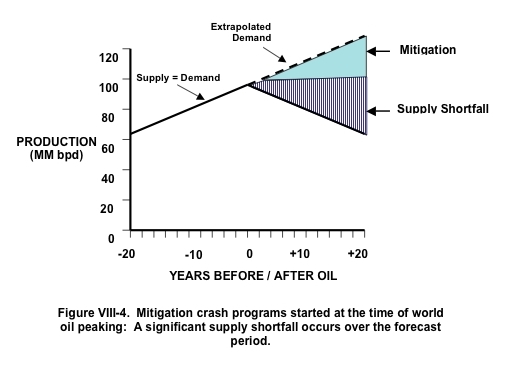
This is a load of baloney, and it all hinges on the word "mitigation". You see, what the Hirsch report means by "mitigation", is an all-out crash program for producing more liquid fuels, as you can see from the following diagram (p. 57):

This program is a pro-Exxon, pro-GM, pro-pollution, anti-conservation, Dick Cheney inspired load of crap, and the authors of the report frankly admit it (p. 50):
B. Mitigation Options
Our focus is on large-scale, physical mitigation, as opposed to policy actions, e.g. tax credits, rationing, automobile speed restrictions, etc. We define physical mitigation as 1) implementation of technologies that can substantially reduce the consumption of liquid fuels (improved fuel efficiency) while still delivering comparable service and 2) the construction and operation of facilities that yield large quantities of liquid fuels.
If you read the report, you'll quickly see that option 1) (lame as it is) is still just lip service. The crash plan is all about pork for oil/coal/refining companies, so they can quickly ramp up liquids production from coal, gas, oil sands, heavy oil and EOR, which are projected to provide 95% of the mitigation. There isn't a word in the entire report about conservation.

The raw stupidity of this plan is evident in the fact that 30% of the mitigation wedge shown in the above diagram is projected to come from heavy oil in Venezuela, as we've seen earlier. The authors do not explain how the United States is going to operate on Venezuelan soil in implementing its crash program to save braindead American motoring.

Still, these facts do not pose a serious problem, even if peak oil is imminent.

This is because it doesn't take decades to mitigate. It takes about 5 minutes -- time enough for the President to sign off on a big fat gas tax. Bing. You kill 4 birds with one stone:

1) Reduce demand for oil
2) Drive demand for alternatives
3) Generate massive revenues for building rail etc.
4) Kick Iran, Venezuela and the rest of OPEC in the nuts, and watch them squirm as oil prices and their government revenues drop like a rock.

Now, of course the doomers are in bed with Dick Cheney, and think that the American way of life is non-negotiable. There is no way in hell that the U.S. will ever pass a gas tax. It turns out this is wrong too. A majority of Americans actually favor a gas tax, provided you spin and package in the right way:
If you ask people straight out, "do you favor a gas tax," the answers is overwhelmingly (85%) No. Even if you promise to reduce other taxes --payroll and income -- by the same amount, the answer is still (63%) No.

But if the question is, "would you support a gas tax if it reduced U.S. dependence on foreign oil" or "would you support a gas tax if it cut down on energy consumption and reduced global warming," the results reverse pretty dramatically. The "foreign oil" question gets 55% in favor and the "energy consumption and global warming" question gets 59% in favorSource
It is imperative to not let status quo mouthpieces like Hirsch et al., abuse the word "mitigation". Peak oil is -- by definition -- not a problem which can be solved on the supply side.
-- by JD

Wednesday, December 10, 2008

384. THE GROWING GLUT

A number of new analyses suggest a growing, long glut:

Oil analyst Philip Verleger claims that OPEC needs to reduce output by at least 7 million barrels a day to balance supply and demand:
Just how daunting is OPEC’s challenge to rein in falling oil prices? Beyond its control, if economist and oil-market analyst Philip Verleger is right.

Mr. Verleger, a former Carter administration official, academic, and energy-industry consultant, says OPEC can forget about tiny production cuts of 1 or 2 million barrels when it meets later this month in Algeria. The cartel needs to wipe out at least 7 million barrels per day of oil production to bring oil markets close to balance, he says, according to Platt’s The Barrel.

And that’s not likely to happen, which spells even more happy times for oil bears, Mr. Verleger says: “Since cuts of such magnitude are out of the question, one should expect prices to come under further downward pressure.”

His thesis? Global demand for oil has cratered much, much more than the spreadsheets used by groups like OPEC and the International Energy Agency. Mr. Verleger says global demand in December dropped to 81.6 million barrels a day, compared with 86.8 million barrels a year ago. That’s dramatically uglier than OPEC’s most recent diagnosis of oil demand, which put fourth-quarter global demand at 86.2 million barrels per day, up from 85.9 million a year ago.Source
Stocks are definitely rising. The oil market is currently in a "super contango", and crude is piling up not only in monitored storage like Cushing, OK, but in tankers parked at sea:
Royal Dutch Shell Plc sees so much potential in the strategy that it anchored a supertanker holding as much as $80 million of oil off the U.K. to take advantage of higher prices for future delivery. The ship is one of as many as 16 booked for potential storage instead of transporting crude, said Johnny Plumbe, chief executive officer of London shipbroker ACM Shipping Group Plc.

Oil Storage

The tankers, if full, hold about 26 million barrels worth about $1 billion, more than the 22.9 million barrels sitting in Cushing, Oklahoma, where oil is stored for delivery against Nymex contracts. U.S. crude inventories rose 11 percent this year to 320.4 million barrels, according to the Energy Department.

“All the market operators keep placing oil in storage,” said Francisco Blanch, head of global commodities research at Merrill Lynch & Co. in London. “Even though the contango is steep, it could get steeper.”Source
More broadly, a new report from the World Bank called Global Economic Prospects 2009(pdf) declares that "Like earlier commodity booms, this one has come to an end." and states:
The strength, breadth (in terms of the number of commodities whose prices have increased), and duration of the current commodity boom have prompted speculation that the global economy is moving into a new era characterized by relative shortage and permanently higher (and even permanently rising) commodity prices. This outcome does not appear likely. Over the next two decades, slower population growth and weaker (though still strong) income growth are projected to cause trend global GDP growth to ease (figure O.3) and, with it, the demand for commodities.
According to Andrew Burns, Lead Author of the report:
Over the longer term, the supply shortages that contributed to the sharp rise in commodity prices are expected to ease. Demand for energy, metals, and food should slow due to weaker population growth and an expected reversal in China’s high demand for metals as investment rates there decline.Source
Now that things have settled down, the commodities price spike/collapse of 2008 is looking more and more like a mundane rerun of the commodities price spike/collapse of the late 70s. Except this time we had a whole army of chicken littles, pumped up by the steroid of the internet, to loudly worry and moralize about it 24 hours a day. Six months ago, we were all going to die because we were running out of everything. Now the same stuff is piling up in overflowing tankers, silos and warehouses.

Peak everything. Honestly, how butt stupid did you have to be to buy into that? How likely is it that mankind was running dry of every single natural resource, at exactly the same time? Not too likely, as we've seen. The only thing that was really peaking was financial overextension and hype.
-- by JD